
Celebrating Disability Blog

Asking About Access Needs on a Form

Key takeaways

  • Explain why you are asking the question and how the information will be used to improve accessibility and inclusion.
  • Avoid forcing people to identify as disabled in order to ask for support. Instead, ask about “access requirements” or “access needs”.
  • Describe what the process, event or interview will involve, so people can better understand what support they may need.
  • Offer examples of possible support or adjustments, to encourage people who may not know what to ask for.
  • Make sure staff are confident responding to access requests, with a clear process for following up and discussing support needs.

Your form collects access needs. Your managers turn them into adjustments that work.
Reasonable Adjustments in Practice is a 3 hour online workshop giving managers the confidence to have practical, positive conversations about reasonable adjustments.
Wednesday 14 October 2026, 10am to 1pm, online.
Book a Spot.

It can’t be emphasised enough how important it is to provide services that are inclusive of both disabled customers and employees. One way to ensure access and inclusion is by asking about access needs on a form. The way you phrase your questions can significantly affect your ability to adapt and to make a disabled person feel included and engaged. If these questions are not well crafted, they could lead to negative consequences for your business.

According to a report by Evenbreak, a disability job board, 12% of disabled applicants reported disclosing a disability at the application stage, and 23% reported disclosing a disability at the interview stage.

Before deciding how to ask the question, it’s important to understand the consequences of not having an inclusive service.

Bias can show up in the engagement process, whether for recruitment or for feedback on a product or service. Unconscious bias from hiring panels and decision makers can be influenced if disability is disclosed on a form.

Asking about a disability on a form may be interpreted as a means to discriminate. If a disabled person is not successful in their application after disclosing their disability, both the candidate and the business might perceive this as discrimination based on disability.

Additionally:

Not every person who requires support identifies as having a disability. Some people may simply tick the “no” box if they do not view themselves as disabled. So asking someone about their disability and receiving a “no” may make the question irrelevant.

Phrasing the question incorrectly may not give you the answers you need. For instance, if you ask a disabled person what their disability is, their answer may not tell you the specific support they require. For example, if I tell you I have cerebral palsy, do you automatically know what support I need?

Building a Truly Inclusive Service

At the form-filling stage, it’s not essential to know whether a person is disabled. Candidates should be evaluated on their qualifications and merits rather than personal characteristics. However, it is crucial to understand people’s access requirements to ensure accessibility and inclusion.

How to Ask About Access Needs and Disability on a Form

You can ask:

“Do you have any access requirements you would like us to be aware of?”

“Access requirements” is my preferred term. However, “access needs” is becoming a popular and widespread term. I think the reason is that “requirement” can be framed as optional, whereas “need” reinforces that it is not.

This question covers a wide range of needs. Access requirements are not limited to disabilities. For example, a parent may need to leave at a specific time to collect their child from nursery, which could mean they cannot attend interviews between 11am and 1pm.

Communicating Your Commitment to Inclusion

Tailoring a service or experience to be inclusive and accessible can significantly improve it for disabled people. It helps them feel valued and welcomed, and gives them confidence to ask for specific support.

Creating the Conditions for Genuine Inclusion

Once you have an appropriate question to gather the information you need, focus on how to frame it to encourage responses. Before asking “Do you have any access requirements you would like us to be aware of?”, consider how to set the scene.

People, especially disabled people, are more likely to engage with your question if they understand why you are asking it. Without that understanding, it’s natural to feel suspicious about how the information will be used. Take time to explain why you are asking, what measures you already have in place for accessibility and inclusion, and how you will use the information provided. This comes up a lot in Celebrating Disability’s [training sessions](link to training page).

When explaining how you will use the information, go beyond GDPR compliance, although that is crucial. Make sure respondents understand how their information will improve their experience. People are more likely to respond honestly when they understand the reason behind the question.

During lockdown, I hosted a series of webinars for the public. Each session included a paragraph explaining how the webinar was designed to be inclusive, why we were asking about access, and how the information would be used. The following screenshot shows the information we provided, with the text written out below.
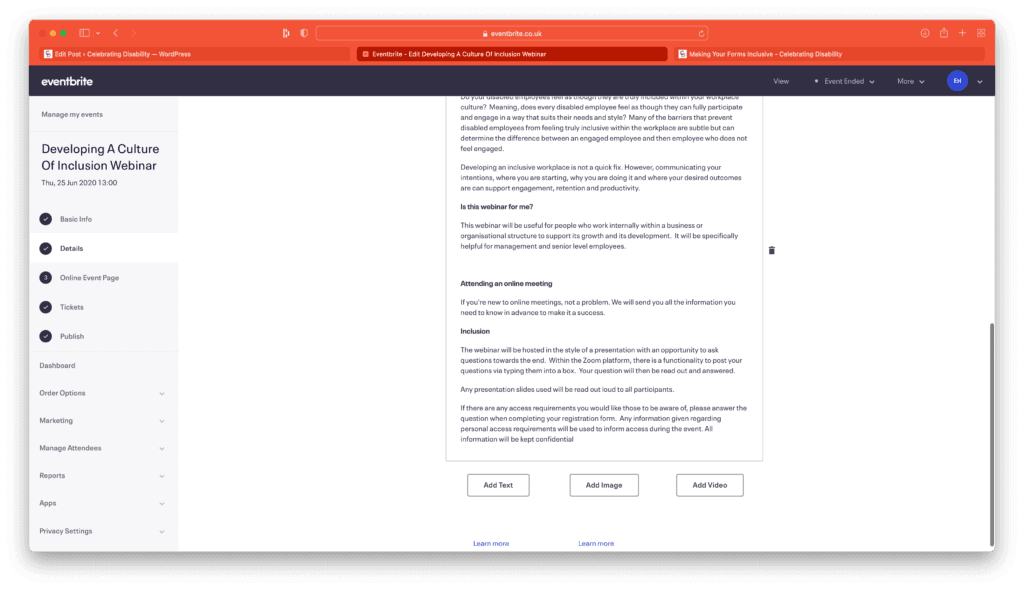
The image contains a screenshot of an Eventbrite page listed by Celebrating Disability when hosting an online event during lockdown. The text within the image talks about accessibility and inclusion during the event and reads: The webinar will be hosted in the style of a presentation with an opportunity to ask questions towards the end. Within the Zoom platform, there is a functionality to post your questions via typing them into a box. Your question will then be read out and answered. Any presentation slides used will be read out loud to all participants. If there are any access requirements you would like those to be aware of, please answer the question when completing your registration form. Any information given regarding personal access requirements will be used to inform access during the event. All information will be kept confidential
Providing information when asking about disability in a form – Celebrating Disability

We provided the following information: We provided the following information:

Inclusion

The webinar will be hosted as a presentation, allowing time for questions at the end. Within the Zoom platform, participants can submit questions by typing them into a designated box. These questions will be read aloud and answered during the session. Any presentation slides used will be read out loud to all participants. If there are any access requirements you would like us to be aware of, please let us know.

Asking the question

So many people are nervous about asking the question. It may come from a fear of the answer. But really, what is the worst that can happen? As a disabled person, I do not sit at home thinking, “How can I make this business’s life more difficult?” Many disabled people have already found ways to manage their disability. The access requirements we have are often free to put in place, or something that should already exist, such as an accessible toilet.

Others don’t ask because nobody has complained in the past, so they conclude there is no need. The reason nobody has complained is that people did not know support was available. They may simply have gone somewhere else.

Make suggestions

Not every disabled person knows exactly what they will need to feel truly included. They may not know what will happen when they arrive, or what support is available. This is where you can fill in the gaps.

Start by explaining what is going to happen and what they will need to do. This might be the process of an interview, or an event they are attending. The more information you offer, the better informed the person can be about the support they may need.

Offer a list of suggested support. This helps disabled people who need more encouragement to ask, and reinforces the message that you are inclusive and want to welcome disabled people into your business.

Offer alternatives

Offering alternatives to an online form makes sure you are not excluding anyone. You might offer a downloadable Word document or a contact number. That number should connect the person with an employee who can help them complete the form, and who has the information they will need.

Engage with the response

When you ask any question, you should have a plan for dealing with the response. What is your process for putting in place the reasonable adjustment an attendee has requested? At the very least, contact the person to thank them for getting in touch, and explain the next steps, if there are any.

If you do not know how to put the requested support in place, be honest and say so. You can work with the person to find a solution that suits them within your budget or limitations. If, after discussion, it is something you cannot provide, talk it through with them. Explain why it is not possible and what alternative you have in mind.

Follow up

After your event, follow up with all your guests and ask how they found it in terms of inclusion and accessibility. Ask whether anyone had access requirements when attending, and ask those who did how they found the experience. Use this knowledge to improve your service in future.

If you take only one thing from this blog, let it be confidence. Too many people avoid the conversation for fear of getting it wrong. It is better to get it wrong and ask how to correct it than not to ask at all.

Ensure staff confidence

Whether you are preparing for inclusive recruitment of disabled candidates or want disabled guests and visitors to have an inclusive experience, your staff need to be confident. Provide resources, training and support so they feel comfortable discussing disability and support needs. Your staff are the gateway to building confidence among your disabled contacts, so it’s important to get it right.

After the Form: Supporting Managers to Have Confident Conversations

Asking about access needs is only the first step. The real work starts once someone answers. Presumably, that person will be joining your workplace. Are your line managers confident about starting regular conversations about support needs? How will access needs become part of the team’s day-to-day work?

This is exactly where many organisations get stuck. The form is right, but managers don’t know what to do next.

Reasonable Adjustments in Practice is a 3 hour online workshop designed for exactly this moment. It gives managers the confidence and practical tools to talk about adjustments, agree what works and keep the conversation going.
Wednesday 14 October 2026, 10am to 1pm, online.
Book a Spot.

Is Your Form Actually Doing Its Job?

Disabled people are unlikely to share their access requirements unless they can see how it will benefit them and feel confident to do so. Compare your forms against the questions below:

  • Have you explained why you are asking the question?
  • Does your form say what you will do with the information and how you will store it?
  • Is there a clear way for people to get in touch to talk further about access needs?
  • Does your form force the reader to identify as disabled in order to ask for support?
  • Do the people writing your forms feel confident asking about access needs?

If any of these answers give you pause, Celebrating Disability can help your managers and hiring teams build the confidence and skills to get it right. Book a call about manager training.

Do the people writing your forms feel confident to ask about access needs? If not, let us help you develop their confidence and skills. Click here to get in touch.
How to Ask About Access Requirements – YouTube video

6 Ways to Embed Disability Inclusion into Everyday Practice

1. Measure progress over attendance

One of the biggest mistakes I see organisations make is measuring success by attendance.

Attendance tells you who was in the room. It doesn’t tell you what happened afterwards.

Disability inclusion training shouldn’t leave people knowing everything. That’s neither realistic nor the goal.

Instead, think about learning as a journey.

Training builds awareness.

Awareness builds confidence.

Confidence develops into capability.

Speaking to Max Horton on The Equality Edit, one point really stood out. He talked about understanding where your organisation is today before deciding where you want to go. Rather than trying to tackle everything at once, he encouraged organisations to understand their current level of maturity, identify their priorities and focus on what will make the biggest difference next.

The same principles apply to developing your training session to support your disability inclusion strategy.

Measure where people are now.

Then decide what support will help them keep progressing. When embedding disability inclusion, ask yourself:

  • Are managers feeling more confident?
  • What conversations have happened since the training?
  • What questions are people asking now?
  • What progress have individuals and teams made?
  • Where do people need more support?

Those answers will tell you far more than a feedback form ever could.

2. Create opportunities for people to keep asking questions

The best questions rarely come up during the training itself.

They usually appear afterwards, when someone has their first conversation about a reasonable adjustment, supports a disabled colleague for the first time or realises they aren’t quite sure how to respond in a particular situation.

Katie Allan’s observation is probably something that every EDI leader can relate to. She explained that many leaders aren’t avoiding conversations because they don’t care. They’re worried about saying the wrong thing. Rather than pretending to have all the answers, she encouraged leaders to acknowledge what they don’t know and create space to keep learning.

I see exactly the same thing with clients.

The questions people ask two weeks after a workshop are often the questions that make the biggest difference.

Create informal opportunities for disability inclusion training for managers to take place.

For example:

  • Monthly drop-in Q&A sessions.
  • Manager discussion groups.
  • Anonymous question boxes.
  • Short virtual clinics after major training programmes.

Every question builds confidence and this confidence will build your disability inclusion strategy into a working practice.

3. Embedding disability inclusion by building confidence through practice

Knowledge and confidence are not the same thing.

Someone can leave an inclusive workplace training session or course understanding the purpose of reasonable adjustments and still feel unsure about leading their first conversation with an employee.

Confidence grows through practice.

Eve’s experience demonstrates this perfectly. She spoke openly about becoming overwhelmed during her occupational therapy placement until the support she received became much more manageable. Breaking learning into smaller, achievable goals allowed her confidence to grow step by step.

The same principle applies to disability inclusion training for managers.

Give managers opportunities to practise.

Work through real scenarios.

Discuss recent situations.

Facilitate peer learning.

Run practice sessions where people can explore different approaches before they find themselves in the real conversation.

Practice transforms knowledge into confidence, and confidence develops into capability.

4. Bring lived experience into disability inclusion training for managers

One of the biggest strengths of disability inclusion training is hearing directly from disabled people.

Don’t let that learning end when the session finishes.

Joe shared how becoming a father completely changed his understanding of accessibility and ultimately influenced the direction of his business. His perspective shifted because disability became personal.

Stories have a unique way of changing perspectives.

Policies explain what organisations should do.

Lived experience helps people understand why it matters.

Keep those voices part of your learning throughout the year.

Share podcast episodes.

Invite guest speakers.

Host panel discussions.

Celebrate stories from your own colleagues.

The more people hear different experiences, the more naturally they begin to think differently themselves.

5. When embedding a disability inclusion, aim for progress over perfection

One of my favourite conversations was with Susi Miller from eLaHub

She openly shared a moment where she realised she had unintentionally excluded someone with a speech access need during a training session.

She didn’t defend her decision. She reflected, adapted and improved her approach.

Andrew reinforced this in our conversation when he reflected on Homes for Students’ ambition to “change the world in a day”. As the project developed, they realised lasting change came from prioritising, listening, learning and building over time rather than trying to solve everything at once.

Inclusion isn’t about getting everything right immediately.

It’s about creating an environment where people feel confident enough to learn, adapt and improve.

Celebrate progress.

Encourage curiosity.

Recognise learning.

That’s how capability grows.

6. Make learning part of your culture

The organisations making the biggest progress don’t necessarily deliver the most training.

They create the most opportunities to keep learning.

Andrew made another point that has stayed with me. Strategies shouldn’t stand still. They should evolve as organisations receive feedback, learn more about their colleagues and respond to changing needs.

Learning should work exactly the same way.

Build inclusion into everyday business.

Spend five minutes discussing a recent scenario during a team meeting.

Ask managers to share what’s working.

Celebrate examples of inclusive practice.

Revisit key themes throughout the year.

Keep the conversation moving.

When learning becomes part of the culture, disability inclusion stops being an annual event and starts becoming part of how people think, lead and work together.

Final thoughts

Disability inclusion training is one of the best investments an organisation can make.

It raises awareness.

It challenges assumptions.

It starts important conversations.

But the workshop isn’t the destination.

It’s the starting point.

Real change happens when organisations continue creating opportunities for people to ask questions, practise new skills, learn from lived experience and reflect on real situations together.

That’s how awareness becomes confidence.

That’s how confidence becomes capability.

And that’s how learning becomes part of everyday practice.

Much of the advice in this article came from conversations on The Equality Edit. To listen to more conversations from experts talk about how they embedded inclusion and equality into their workplace, click here to visit The Equality Edit on our website or search for The Equality Edit on Spotify, YouTube or Apple Podcasts.

Lived Experience Alone Does Not Create Inclusion in the Workplace

In my recent conversation with Joanne Lockwood on The Equality Edit, this came through clearly. We spoke about the value of personal experience, the emotional labour that often sits behind it, and the gap that still exists between hearing someone’s story and knowing what to do differently as a result. Again and again, the conversation came back to the same point. Awareness matters, but awareness without action changes very little.

Why lived experience feels powerful, and where it falls short

There was a time when I was very clear that I did not want to centre myself in my work. When I started Celebrating Disability, the focus was inclusion, not my personal story. Over time, that shifted. Not because the purpose changed, but because I realised that lived experience is often what makes inclusion in the workplace tangible for other people. It helps people understand the impact of barriers in a way that theory never quite can.

But there is a limit to what lived experience can do on its own.

Sharing personal experience can create empathy. It does not automatically create action.

What it does not do is help a business understand how to change its processes, how to support its managers, or how to embed inclusion into day to day working practices. It does not tell someone how to respond in a real conversation, or what to do when a situation becomes complex.

That is where the gap sits. Lived experience can open the door, but it does not build the structure that needs to come after.

Moving from awareness to action in inclusion in the workplace

Organisations start with the best intentions; they invest in awareness, bringing in speakers and creating space for people to share lived experiences. People listen, they reflect, and they often leave with a stronger emotional understanding.

But inclusion in the workplace cannot rely on people simply caring more. It has to help people act differently.

That means translating feedback into something practical. It means asking what this looks like in recruitment, in performance management, in team communication, and in leadership behaviour.

This is where many organisations struggle with inclusion in the workplace, particularly when moving from awareness into action.

Without that step, inclusion remains something that is talked about rather than something that is consistently experienced.

Why fear stops people from engaging

One of the biggest barriers to inclusion in the workplace is not resistance. It is fear. People are worried about getting it wrong. They worry about using the wrong language, asking the wrong question, or causing offence without meaning to.

Fear does not create safer environments. It creates silence.

This shows up in everyday ways. Managers delay conversations they know they need to have. Colleagues avoid asking questions that might actually improve understanding. Decisions are pushed down the line because people do not feel confident enough to act.

The impact is simple. Support is delayed. Barriers remain. And disabled people are left to navigate those gaps on their own.

The role of line managers in making inclusion real

This is where inclusion in the workplace either succeeds or quietly falls apart. Not at senior leadership level, and not in policy documents, but at line manager level.

Many managers want to do the right thing. The challenge is to ensure the right tools are in place to turn theory into practice. As a result, enabling line managers to have confidence when engaging in conversations about adjustments and support, because clear guidance has been provided.

Inclusion does not fail because people do not care. It fails because people do not feel confident.

Building manager capability is critical. Not just awareness, but practical confidence in real situations.

We support organisations to develop line manager confidence and skills through comprehensive, tailored training.

The emotional labour behind inclusion

There is another layer to this that is often overlooked. For many disabled people, inclusion in the workplace is not an occasional topic. It is something that is navigated every day.

That includes explaining needs, managing other people’s reactions, advocating for support and staying composed in situations that can be frustrating or exhausting.

Inclusion often comes with invisible labour that organisations do not measure.

Even in organisations that are trying to improve, this can take a significant amount of energy. There is often an unspoken expectation that individuals will educate others while also doing their job.

That expectation is rarely acknowledged, but it is very real.

Why inclusion needs to be built, not requested

Too often, inclusion in the workplace is treated as something that happens in response to a request. Someone speaks up, explains their situation, and then support is considered.

By that point, the responsibility has already been placed on the individual.

Inclusion should not depend on someone having to ask for it every time.

A more effective approach is to build inclusion into the culture from the start. That means thinking ahead about how people work, how flexibility is approached, and how conversations are handled.

Leadership, culture and everyday behaviour

Leadership plays a critical role in shaping inclusion in the workplace. Leaders influence what is prioritised, how people behave and what is considered acceptable.

Inclusion is not driven by statements. It is driven by behaviour.

If leaders demonstrate openness, accountability and a willingness to learn, that creates space for others to do the same. If they avoid difficult conversations or focus only on outputs, that also filters through the organisation.

Leaders who demonstrate the values, behaviours, mission and purpose of the organisation of the ones that support an inclusive culture to grow.

Inclusion is not about doing something completely different

There is a common assumption that inclusion in the workplace requires a completely different way of working. In reality, it often builds on what people already know how to do.

People already adapt to different personalities, support their friends in different ways and respond to individual preferences in their personal lives.

Inclusion is not a new skill. It is a consistent application of what people already know.

The challenge is bringing that into the workplace in a way that is intentional and sustainable.

Why perfection is not the goal

There is often pressure to get inclusion in the workplace right all the time. That is not realistic. People will make mistakes. They will have days where they do not respond in the best way.

What matters is not perfection. It is accountability.

Awareness, ownership and a willingness to improve are far more important than getting everything right the first time. That is what builds trust over time.

Turning lived experience into meaningful change

Lived experience remains a vital part of inclusion in the workplace. It brings clarity, honesty and perspective. It helps people understand the real impact of barriers in a way that theory cannot.

But it cannot carry the full weight of change on its own.

For organisations, the focus needs to shift towards building capability. That includes supporting managers, embedding inclusive practices into everyday work, and ensuring that people know how to act on what they have learned.

A few practical questions can help highlight where the gaps might be:

  • Do managers feel confident having conversations about support and adjustments
  • Does inclusion in the workplace show up in daily behaviour, or mainly in policy documents?
  • Are disabled people expected to carry the responsibility for driving change?
  • Has the organisation invested in implementation, not only awareness?
  • Do people know what to do after hearing lived experience?

Inclusion in the workplace becomes meaningful when insight leads to action.

Lived experience can start the conversation, but it is what happens next that determines whether anything actually changes.

What to do next

If these questions are difficult to answer, that is where the risk sits.

Inclusion in the workplace does not improve on its own. It moves when action is taken.

If there is already a sense that things are not quite working, or that managers are unsure how to respond in real situations, now is the time to address it.

Celebrating Disability use lived experience within the delivery of our services. But only as an addition to driving change through the behaviour and purpose. If you are interested in how we can support you through value-driven training and talks, we’d love to talk with you.

Why Reasonable Adjustment Conversations Aren’t Happening

The Gap Between Reasonable Adjustments Policy and Practice

Over the past year, I have worked with multiple organisations investing in training for line managers responsible for reasonable adjustment conversations. A common frustration emerges: the policies exist, but implementation is inconsistent. This is not a knowledge deficit. It is a capability deficit. Knowing that reasonable adjustments are a legal duty under the Equality Act does not automatically equip someone to manage a nuanced conversation about fluctuating needs, performance expectations, or team impact. Policy creates structure. It does not create fluency. Without rehearsal, managers default to caution.

Line Managers Avoid Reasonable Adjustment Conversations

Line managers understand that there are real consequences attached to adjustment conversations. They are aware of potential grievances, tribunal risk, and reputational damage. That awareness shapes behaviour. And internal calculation often happens.

If I say the wrong thing, this could escalate. If I agree to something unreasonable, I expose the organisation. If I open this conversation, I may not know how to resolve it.

Avoidance feels safer in the short term. Silence feels like risk management. But silence is not neutral. For disabled employees, hesitation can communicate doubt. Delay can communicate disbelief. A postponed reasonable adjustment conversation can feel like rejection, even where there is no malicious intent. The harm does not require hostility. It only requires inaction.

Misunderstanding What “Reasonable” Means

Another recurring issue is confusion around what reasonable adjustments involve and what the term “reasonable” actually protects. Many managers overestimate cost and underestimate flexibility. They assume complexity before asking a single question. In practice, most reasonable adjustments are practical and low cost. Reasonableness is built around proportionality and this safeguards organisations from disproportionate burden while protecting disabled people from systemic disadvantage. When managers genuinely understand this balance, fear reduces significantly. Clarity reduces defensiveness and increases action.

Why Reasonable Adjustments Training Must Go Beyond Awareness

Delivering a single disability inclusion workshop does not create behavioural change. If line managers are expected to lead reasonable adjustment conversations confidently, they need repeated opportunities to practise and reflect. That means structured case studies, safe rehearsal environments, and space to explore what happens when conversations feel uncomfortable. It means analysing examples of what worked well and where small language shifts changed outcomes.

This is why our Reasonable Adjustments Training at Celebrating Disability is designed around application, not just awareness. I explored this further in my recent Thinking Out Loud episode on the silence around reasonable adjustments, where I unpack why compliance without confidence creates organisational risk.

Organisational Priorities Shape Reasonable Adjustment Conversations

There is a deeper structural issue that is often overlooked. What is genuinely prioritised inside the organisation?

If speed, productivity, and immovable deadlines are consistently rewarded above all else, managers receive a clear signal. Inclusion becomes secondary. Reasonable adjustment conversations become optional.

But…

If inclusion is the priority, leadership must communicate that clearly and operationalise it. That may involve shifting deadlines, adjusting team expectations, or giving managers explicit permission to slow down in order to support someone properly.

Avoiding reasonable adjustment conversations does not eliminate risk. It compounds it. Silence increases the likelihood of grievance and tribunal. It suppresses disclosure rates. It undermines trust. Over time, it signals to disabled employees that belonging is conditional. That is not a policy issue. That is a culture issue. And culture is shaped by behaviour, not documentation.

From Silence to Skilled Reasonable Adjustment Conversations

The barrier is rarely intent. It is capability. It is clarity. It is organisational permission. The most effective line managers are not necessarily the most naturally confident personalities. They are the ones given structured opportunities to practise, ask questions, and prioritise inclusion without fear of penalty. If reasonable adjustment conversations are not happening in your workplace, the question may not be whether managers are compliant. It may be whether they feel equipped.

Why Measuring Disability Inclusion Matters and How to Start

Without disability inclusion metrics, disability inclusion often remains invisible. It sits in HR folders, policy documents, or one off initiatives rather than becoming part of how the organisation understands performance, risk, and culture. When inclusion is not measured, it is harder to protect, harder to fund, and easier to deprioritise.

Measurement is not about surveillance or bureaucracy. It is about understanding where barriers exist, whether support is effective, and what needs to change. For organisations that are already doing something, measurement is the point where activity becomes strategy.

Measurement is the bridge between intention and impact

When disability inclusion is not measured, the same patterns tend to appear.

Leaders assume inclusion is working, without evidence. Training has happened, policies exist, so it feels like progress. But without outcome data, leaders cannot see whether disabled people are actually experiencing timely support, psychological safety, or equal opportunity. This creates a false sense of confidence and prevents meaningful improvement.

Barriers remain hidden and normalised. Delays in reasonable adjustments, inconsistent manager responses, inaccessible systems, and informal workarounds often go unrecorded. When barriers are not measured, they become part of everyday working life rather than problems to solve. Over time, this increases frustration, fatigue, and disengagement among disabled staff.

Disability inclusion becomes fragile. When budgets tighten or priorities shift, work that cannot demonstrate impact is often the first to be questioned. Without data, disability inclusion is easier to frame as optional rather than essential. Measurement protects the work by showing why it matters.

Trust and disclosure stagnate. Disabled people are less likely to disclose when previous disclosures have led to little change. Low disclosure then limits the quality of data available, creating a cycle where leaders say they cannot act because they do not have enough information. Measurement done well breaks that cycle by showing that disclosure leads to action.

From a business perspective, this matters because unmeasured barriers affect productivity, retention, engagement, and reputation. These costs rarely appear labelled as disability related, but they show up elsewhere in the data.

What measuring disability inclusion actually means

Measuring disability inclusion is not just about headcount. It is about understanding experience, outcomes, and systems.

Effective measurement looks at whether reasonable adjustments are delivered consistently and on time, whether managers feel confident supporting disabled staff, whether disabled people feel safe disclosing and asking for support, whether disabled staff stay, progress, and thrive at similar rates to non disabled staff, and where organisational systems create friction or delay.

Celebrating Disability delivers training sessions that support line managers to understand their responsibilities and obligations towards disabled people in terms of reasonable adjustments and equality at work, to find out more, click here to see our sessions.

One widely used approach is an inclusion index, which brings together responses on belonging, safety, fairness, and support into a single score that can be tracked over time. This allows organisations to see patterns, compare teams or functions, and assess whether change efforts are working.

There is growing professional demand for practical ways to measure inclusion, not just talk about it. That shift reflects a broader recognition that inclusion needs to be managed with the same seriousness as other organisational priorities.

The business cost of not measuring disability inclusion

Organisations that do not measure disability inclusion often experience the same operational issues, even if they are not labelled as inclusion problems.

Retention risk increases. When adjustments are delayed or inconsistent, disabled employees are more likely to reduce hours, disengage, or leave. Replacement costs, lost knowledge, and disruption to teams all carry a financial impact.

Manager time is wasted. Without clear processes and data, managers often rely on informal advice, repeated conversations, or trial and error. Measurement highlights where managers need better systems or guidance, reducing inefficiency.

Legal and reputational risk rises. Untracked delays or inconsistent decisions around adjustments increase the likelihood of grievances or disputes. Measurement provides early warning signs before issues escalate.

Inclusion work lacks credibility. When disability inclusion cannot demonstrate outcomes, it is harder to secure long term investment. Measurement gives leaders confidence that resources are being used effectively.

Research consistently shows that workplace adjustments support productivity and retention. In Business Disability Forum’s Great Big Workplace Adjustments Survey, many disabled employees reported that adjustments helped them stay in work and perform better. That link between support and performance is exactly what measurement makes visible.

Five practical ways to start measuring disability inclusion

These steps are designed for organisations that already have some disability inclusion activity in place and want to embed measurement into their strategy.

1. Define outcomes, not activities

Start by being clear about what success looks like.

Examples of outcomes include adjustments being implemented within agreed timeframes, managers feeling confident having conversations about disability and access, disabled staff reporting higher levels of psychological safety, disclosure rates increasing because trust exists, and disabled staff retention improving.

Once outcomes are clear, identify simple indicators that show progress. For example, measure average time from adjustment request to implementation rather than counting how many requests were made.

2. Build trust in disability data

Disability data is sensitive. People will only share it if they understand why it is collected and how it will be used.

Key foundations include clear communication about purpose and impact, inclusive categories with a free text option, separation of disability data from performance management, and transparency about who can access the data and why.

If trust is missing, data quality will be poor and measurement will fail.

3. Use reasonable adjustments as your first dashboard

If a reasonable adjustments process exists, you already have a strong starting point.

Useful measures include time from request to decision, time from decision to implementation, percentage of requests implemented fully or partially, common reasons for delay, and repeat or escalated requests.

These metrics quickly reveal where systems support inclusion and where they create barriers.

4. Measure lived experience, not just numbers

Headcount does not show whether inclusion is working.

Add lived experience measures such as short pulse surveys on belonging, safety, and support, manager confidence checks on adjustments and conversations, and structured listening sessions reported as themes.

This data shows whether policies translate into everyday reality.

5. Turn measurement into action

Measurement only builds trust if it leads to change.

Embed disability inclusion metrics into business rhythm by assigning a senior owner for inclusion data, reviewing key indicators regularly, reporting alongside other people metrics, and sharing what has changed because of the data.

When people see action, confidence in the process grows.

Common questions leaders ask

Why measure disability inclusion when we already have policies?
Policies show intent. Measurement shows impact. Without data, it is impossible to know whether policies are improving lived experience or simply existing on paper.

Will measurement slow things down?
Clear metrics often speed things up. They focus effort on the most significant barriers and reduce wasted time on initiatives that do not deliver results.

Inclusion includes feelings, but patterns are measurable. Combining quantitative indicators with qualitative insight provides a robust picture of what is happening and why.

Moving Beyond Awareness. What Inclusion Really Means for Disabled People at Work

Recently I had a conversation as part of a history and storytelling project. It brought me back to what inclusion feels like in daily life. Some things I shared were personal. Others were about how society responds to disabled people. All of them highlighted the same issue. Awareness and adjustments alone do not create belonging. For workplaces, this is where the work truly begins.

Acceptance is not the same as inclusion

People often say their workplace is welcoming to disabled people, but what they usually mean is that they are not openly discriminatory. Acceptance is passive. Inclusion is active. This difference sits at the heart of strong disability inclusion strategies for workplaces.

During the conversation I was struck by how often spaces appear friendly but are still full of barriers. These barriers are not created on purpose. They appear because nobody thought about disabled people before decisions were made. It is the same in many workplaces. A team may get on well. Meetings may feel positive. However, the design of the organisation still assumes non-disabled norms.

This is where understanding the difference between access and inclusion becomes essential. You can watch more about that here in our animated video on the difference between accessibility and inclusion.

Inclusion means anticipating needs before someone arrives. It means designing environments, expectations and behaviours that already work for disabled people. It means applying workplace accessibility beyond compliance, rather than reacting when someone raises a concern.

Awareness cannot remove barriers on its own

Awareness training helps colleagues understand disability, but disabled people still face daily barriers that awareness alone will never remove. This is why workplace accessibility beyond compliance must sit alongside training.

In everyday life, barriers show up in small but significant ways. Accessing services. Travelling. Navigating attitudes. The barriers come from how environments are designed and how people behave, not from disability itself.

Workplaces are no different. A company may offer disability awareness sessions yet still have inaccessible digital systems, unclear procedures, nervous managers or rigid processes. Without structural change, awareness becomes information rather than transformation. To move forward, practical ways to support disabled employees need to be built into the entire organisation.

The emotional load that inclusion should lighten, not increase

One reflection from my conversation was about the amount of thinking that happens before I even start my working day. Planning support. Managing travel. Preparing for attitudes. Navigating fatigue. All of this sits alongside being a professional and a leader.

Disabled colleagues often carry the same emotional load. Re-explaining needs. Working around systems that were never designed with them in mind. Dealing with assumptions and attitudes. This is the invisible emotional effort that sits behind every working day.

Strong disability inclusion strategies for workplaces should reduce this load, not add to it. Inclusion is not only about adjustments. It is about removing the repeated labour disabled people are often expected to carry on their own.

The Equality and Human Rights Commission explains what organisations are legally required to offer as reasonable adjustments. It is important guidance, but it represents the floor, not the ceiling. Inclusion grows when workplaces use this as a starting point rather than the end of the journey.

Physical disability has slipped out of focus

Across the EDI sector there has been a noticeable shift. Mental health and neurodiversity receive growing attention. That awareness is important but it has created an unintended gap. Physical disability, particularly for people who need higher levels of support or mobility aids, often receives far less focus in workplace plans.

This leads to strategies that assume invisible disabilities but overlook physical access. It leads to adjustments that suit some colleagues but do not address the needs of others. It leads to networks and initiatives that unintentionally marginalise physically disabled people.

To move forward, organisations need to include physical disability clearly and confidently within their plans. This is a key part of workplace accessibility beyond compliance and should sit at the centre of any balanced EDI approach.

Everyday inclusion also depends on empathy

I remembered moments during my conversation when a simple act of support could have removed a barrier but someone chose not to help. These moments are not dramatic but they tell you everything about culture. They show whether people notice or whether they wait to be asked.

The same thing happens in workplaces. A colleague hesitates to offer help. Someone ignores a small request. A manager avoids starting a conversation. These individual actions shape culture far more than any policy.

Inclusion grows through tiny moments. A willingness to notice, act and make space for someone without needing permission. That is what workplace accessibility beyond compliance looks like in daily behaviour.

Compliance is the starting line, not the finish line

It is easy to assume that if a workplace complies with the Equality Act, it must be inclusive. Compliance matters. It protects rights. But it does not guarantee belonging. An organisation can meet every legal requirement and still be inaccessible in practice.

Policies can exist without meaningful follow through. Managers can feel unsure about applying adjustments. Systems can remain rigid. Culture can override good intentions. This is why disability inclusion strategies for workplaces must go further than legal standards.

If legislation disappeared tomorrow, would your organisation still be inclusive?

That question helps us understand whether inclusion is cultural or simply contractual.

Resilience should not be a requirement

Disabled people often appear resilient because they have no choice. Over time, constantly pushing against barriers wears people down. In a truly inclusive workplace, resilience is not a requirement for participation. People should not need extraordinary strength simply to access ordinary opportunities.

A thoughtful moment. What this means for everyday practice

As EDI professionals and leaders, there is a real opportunity to shift from awareness to action. These reflections can support that journey.

• Bring physical disability to the centre of your strategies.
• Review processes to identify where disabled staff carry repeated labour.
• Build empathy into daily behaviour and expectations.
• Look at your organisation through a prevention lens, not an adjustment lens.
• Value disabled colleagues as partners in shaping solutions.
• Treat inclusion as culture, not compliance.
• Consider lived experience as evidence.
• Design with disabled people in mind from the beginning.

Inclusion becomes real when disabled people step into a workplace and already feel thought of. Not accommodated after the fact. Not managed as an exception. Thought of from the very start.

That is when awareness begins to transform into belonging.

Ensuring Your Disability Inclusion Efforts Are A Success

Many of these strategies have been very successful.  These have included:

  • Centralising the funding pot for reasonable adjustments. Enabling managers to concentrate on what is needed for a disabled employee to achieve. Instead of considering how this will fit into their budget.
  • Continuous line manager training for new recruits.
  • EIAs completed for every new process or policy introduced.  Limiting the risk of inequitability.

The one thing that always works is when a company develops its culture from the top down. Continuously demonstrating it will not accept anything but the standards it sets for true inclusion and equality.

Unfortunately, there’s no quick fix although there are some quick wins. So, in this blog, we will explore how a culture which centres disability inclusion is built and sustained. 

Understanding your why

I know I bang on about this all the time. But this is because it’s so important. If you don’t understand why you’re doing something, you won’t prioritise it. It will quickly go to the bottom of the to-do list. Consider the Eisenhower Matrix:

Without defining the reasons why, disability inclusion will quickly fall to the not important, not urgent category. 

The good news is that coming up with your why is not something you need to do or even should do alone. Involving your workplace, your ERGs or disability networks, utilising those annual staff surveys, and asking for general feedback are always in which you can start to gather ideas that will develop your strategy.  

You may not be surprised to hear that Celebrating Disability can help with this as well. 

Our guest talks give opportunities for participants to share their feedback in anonymous way so that they always remain psychologically safe and in control of those thoughts and ideas. At the same time, learning something new and solution focused to implement into their workplace. 

We have also worked in the past with organisations to develop content with the ERGs, disability networks and people that are immediately affected by the outcome.

However you do it, remembering the following is key:

  • People will only share if they understand why you are asking. I’ve mentioned twice now about psychological safety. And this is because this is key. If people don’t feel safe to answer the question, they won’t engage. It is imperative that it is articulated why you are asking, what you were going to do with the information and how people will be fed back to.
  • Understand what you were asking. Define what you want to know the answer to. If it’s more than one thing, that’s okay but try and separate them out. The more you can communicate what you want to know, the more people can help you answer the question. Open questions can work but it’s still important to understand what the aim of asking that question is.
  • It is not a once and done. But rather a rinse and repeat.  Meaning you don’t just ask a question once and then stick with the solution for evermore. You use that for your jumping off point but you can refine and revisit regularly.

Keep in mind that they may be many different reasons for why disability inclusion is a good idea. This can include the morality case for disability inclusion but it may also include the business and commercial case. There’s nothing wrong with this. 

Personally, I spent years avoiding the commercial case for disability inclusion. Over the last couple of years, I’ve come to realise that there’s nothing wrong with that: we as disabled people want to have a positive impact on society in the economy and one does not work without the other!

Assessing where you are

Now that you understand your why, it’s time to assess where you are against where you want to be. This may include a gap analysis assessment or desktop audit. This can be done internally or externally.  

You may even want to do an access audit. This is looking at your physical environment to understand where the barriers are to achieving your why from a built environment perspective.

Your gap analysis assessment (or desktop audit) should include:

  • Opportunity for key stakeholders to share their views.
  • Surveys for employees to share their opinions and views.
  • An analysis of how your policies, processes, templates, guidelines and any other documents enable or restrict how you will achieve your goal.

Done well and thoroughly, this assessment will give you a priority list to start.

Obviously, depending on where you are at the end of your gap analysis assessment (desktop audit), this will determine your next steps. So from now on, I will talk about some general strategies that will ensure disability inclusion is a systemic priority for your business.

Reasonable adjustments

Adjustments really are the key to success. The process for these can be as arduous or as simple as you would like to make them.

A personal tail

I am a member of a business mentoring group. This is a small business where they focus on enabling business owners to succeed. The ethos of inclusion comes naturally to this business. However, the implementation isn’t always obvious. What is clear is their commitment in making me feel valued and included in every activity that I take part in. The business makes this easy by having open conversations with me about what I need and how it can be implemented. This is an example of how it can be simple.

Depending on the size of the business, adjustments are easier or harder to get sign off on. But this is a process driven decision. If processes are open and fluid, it does not need to be difficult. An adjustment for a disabled person is the difference between successfully being productive as well as being part of the workplace culture and not. It’s a simple as that.

Systems for adjustments

Disabled employees that they choose to stay in a certain department/certain role because they have a good line manager. A line manager who displays empathy and compassion. Can competently navigate reasonable adjustments and understands that they are the key to success.

This is brilliant. It shows that there are people within businesses that really embrace the notion of equitable opportunities for everybody. However, we need to ensure a disabled person does not have to stay in a department because they worry about the alternative. Disabled employees should feel confident to progress, try different things, explore different roles without the fear of lack of support from their new line manager and team.

This is why centralising the system is so important. Not only centralising the system so that a line manager can have that conversation but can easily access what they need to support their employee. But training those line managers to understand what their responsibilities are and how to carry those out.

Being brave to have the conversation

Reasonable adjustments and engaging in conversations about support is imperative to ensuring this opportunity is achieved. We know that talking about disability is uncomfortable for people. We don’t want to say the wrong thing, we don’t know what to do with the answer, we don’t know what to ask. But it is so important that we become comfortable with the discomfort. Because if a line manager does not take the responsibility and the initiative to ask these questions, the disabled employee cannot demonstrate what they are capable of to the full extent.

There is no magic step or magic question to enabling everything to be shared at once. And there can’t possibly be.  Because the more a disabled person learns about their role, and learns about their line manager and their team, the more they will feel confident and able to share what they need.

It is about enabling an opportunity for that person to feel safe, secure and informed about what they need and how they may need it. It’s trial and error.

Your recruitment process

A few years ago, recruitment was very popular and very much a priority for businesses and organisations we were working with. For obvious reasons.

  1. A disabled candidate must be able to access the process in order to be considered.
  2. A disabled candidate must be able to feel a sense of belonging and safety when engaging and being introduced to your workplace.

However, over the last couple of years, this hasn’t been much of a priority in the services we have provided. Maybe because people are on top of this, maybe because there’s something new for people to think about. But it is a priority, it must be thought of.

Ensuring a disabled candidate can access the process.

This means being able to physically and cognitively engage in this process. From completing the application form, identifying with the job description and requesting support. It also means ensuring recruiters are enabling fair opportunities to demonstrate ability and be equally considered in the shortlisting process. We have created a fictional case study to consider the barriers that disabled people face in the recruitment process. This case study is available to download by clicking here.

Onboarding

We often consider the onboarding process as an opportunity to assess a new recruit over a period of time. We use this time to ensure they can achieve the outcomes of the role that are set out for them. We introduce them to the business, the ways of working, the specific team and the expectations that are set upon them.

This also must be an opportunity for the disabled employee to showcase ability. The only way they can showcase their ability is if they have the right support in place. 

Continuous development and training

Returning to the notion this is not a one time fix. Instead, a long-term systemic culture change, continuous development is imperative to upholding the standard. This will be in the form of:

  • Training in key areas of inclusion with key stakeholders. These can include line managers, HR, team members during their onboarding.
  • Information events.
  • Resources.
  • E-learning. If created and distributed responsibly.

What now

There’s no shortcut to getting it right. Building an inclusive workplace culture takes commitment, curiosity and a willingness to learn from experience. When reasonable adjustments are made easily and confidently, and when everyone understands their role in creating equality, inclusion stops being a tick-box exercise. It becomes who the organisation is. That’s what real disability confidence looks like; a culture that keeps evolving, because the people in it keep learning.

Creating Equitable Opportunities for Disabled Employees

Recruitment is often the first place businesses focus when thinking about disability inclusion. And it matters. If disabled people are not included in recruitment processes, they may never get the chance to bring their skills into the workplace. But recruitment is only one step. True inclusion is about what happens next. It is about how day to day practices, adjustments, and culture either enable or stop disabled people from achieving.

For leaders, EDI professionals, and L&D heads, the challenge is to recognise what stops disabled people from achieving at work, and to remove those barriers so businesses can focus on ensuring disabled people achieve. That is how inclusion becomes business as usual.

What Do We Mean by “Barriers”?

Through the social model of disability, disability is not created by a person’s impairment but by the barriers around them. In the workplace, barriers are anything that prevent disabled people from achieving their potential, contributing fully, or being recognised for their skills on equal terms.

Barriers are not always obvious. They are often cultural, systemic, or attitudinal. This is why senior leaders play such a critical role in challenging and reshaping them.

For further context on legal duties, see the Equality Act 2010: guidance.

Common Workplace Barriers

1. Attitudinal barriers

  • Assumptions about what a disabled person can or cannot do.
  • Talking over colleagues or avoiding conversations altogether.
  • Overprotection that unintentionally limits growth.

2. Systemic barriers

  • Rigid policies around working hours or performance measures.
  • Processes that rely on one way of doing things, such as all staff meetings without breaks or inaccessible software.
  • Adjustment processes that are complex or slow, discouraging colleagues from requesting support.

3. Environmental barriers

  • Office layouts that make navigation difficult.
  • Meeting rooms or breakout spaces without hearing support or quiet zones.
  • Emergency procedures that overlook disabled colleagues.

4. Communication barriers

  • Information shared only verbally or only in writing.
  • Lack of accessible formats such as captions, large print, or plain language.
  • Digital platforms or intranets that do not meet accessibility standards.

Why Leaders Need to Focus on Ensuring Disabled People Achieve

Removing barriers is not simply a matter of compliance or doing the right thing. It is a strategic decision with clear business outcomes. If barriers remain in place, they stop disabled people from achieving and prevent businesses from creating equitable opportunities for disabled employees.

1. Retention and engagement
When disabled colleagues face barriers, they may feel undervalued or disengaged. This drives turnover and results in the loss of skilled staff, along with the hidden costs of recruitment and retraining. A workplace that creates equitable opportunities for disabled employees fosters loyalty and long term engagement.

2. Productivity and performance
Workplace barriers mean employees are forced to work around obstacles instead of focusing on outcomes. This lowers productivity and increases frustration. Inclusive adjustments such as flexible working or accessible technology ensure disabled people achieve on equal terms. They also improve performance across entire teams.

3. Leadership confidence
When managers do not know how to talk about adjustments, they may avoid the conversation. This creates uncertainty for both parties and undermines trust. Leaders who are equipped with practical tools can initiate conversations that unlock potential. This ensures disabled people achieve while strengthening team cohesion.

4. Commercial resilience
Ignoring barriers restricts the pool of talent, ideas, and innovation. Inclusive businesses build resilience and agility by ensuring disabled employees contribute fully to growth. Creating equitable opportunities for disabled employees is not just socially responsible, it is commercially smart.

5. Brand and reputation
Reputation matters. Businesses that fail to support disabled colleagues risk being seen as exclusive or outdated. On the other hand, those that demonstrate a commitment to ensuring disabled people achieve send a clear signal of values to customers, clients, and investors. This strengthens their competitive edge.

Shifting from Barriers to Opportunities

The good news is that barriers can be dismantled. For leadership, this begins with three commitments:

  1. Listen and learn – Create safe spaces for disabled colleagues to share their experiences. Feedback must be heard, acted upon, and built into business processes.
  2. Act with agility – Treat adjustments as an enabler, not an exception. Quick, proactive responses show commitment to creating equitable opportunities.
  3. Embed inclusion – Inclusion cannot be an add on. It needs to be part of everyday systems, policies, and behaviours. This is how disabled people achieve consistently.

Moving Forward

Every business will face different challenges. All can benefit from reflecting on one central question:

“What might be unintentionally stopping disabled people from achieving in this business?”

For some, the answer may lie in leadership behaviours. For others, it may be hidden in processes, systems, or the physical environment. Whatever the case, when businesses act with intent, three outcomes follow:

  • Disabled colleagues feel valued, supported, and able to thrive.
  • Managers gain confidence in leading inclusive teams.
  • Businesses create equitable opportunities for disabled employees, and reap the rewards of a culture where everyone can achieve.

Recruitment opens the door. But it is the day to day experience of work, the adjustments, the culture, the conversations, that ensures disabled people achieve, progress, and thrive.

Ready to take the next step?

Download our free resource: How to Consider Proactive Adjustments. This practical guide helps leaders and managers anticipate barriers, focus on role outcomes, and create equitable opportunities for disabled employees.

Why Is Inclusive Recruitment Important? Creating Inclusive Recruitment Processes That Work

For many disabled applicants, that is not just a one-off experience. It is a typical pattern.

If you are wondering why inclusive recruitment is essential, this is one reason. Inclusive recruitment processes are about far more than ticking a box. They are about creating an environment where every applicant, particularly disabled applicants, can show their strengths without unnecessary barriers getting in the way.

The recruitment process sends strong signals about who belongs in an organisation. Before the job offer, before the interview, even before the application begins, disabled applicants are already forming an impression. They are asking: Is this a workplace where I can be myself? Will I be supported to succeed?

If the process is clunky, confusing, or silent on access, the answer often feels like “no.”

Why Inclusive Recruitment Still Gets Overlooked

Despite growing awareness of disability inclusion, recruitment remains one of the least adapted parts of many organisations.  An article in the Financial Times reports that disabled jobseekers in the UK submit 60% more applications than non-disabled people, yet only about half receive an interview.  Energy might go into inclusive language or unconscious bias training, but often, the structure of the hiring process remains the same. This is a missed opportunity.

Disabled applicants bring enormous value to organisations. But that value gets lost if barriers are not removed from the very start. Inclusion needs to begin with the first interaction. Otherwise, disabled applicants will never get through the door, let alone thrive.

When hiring managers and HR teams understand how barriers are created, and more importantly, how to remove them, they can design a recruitment experience that works for everyone.

Itching for more on this? Our blog on Recruiting Disabled People into the Workplace dives deeper into the why and how.

Designing Processes That Empower

Inclusive recruitment begins with intention. When organisations take the time to consider accessibility from the outset, disabled applicants experience a smoother, more empowering journey.

  1. Start with the job description. Does it make clear that access needs are welcomed? Is there a named contact for queries? These small details matter. They show openness. They build trust.
  2. Next, look at the platform. When application forms work seamlessly with assistive technology like screen readers, disabled applicants can complete them independently. That functionality signals that the organisation has thought about access beyond legal minimums. It shows care. It encourages more applications from disabled people.
  3. And when disabled applicants are invited to share their access needs proactively, it reduces pressure. Instead of waiting for a candidate to disclose, inclusive recruiters take the lead. They clarify that adjustments are part of the process, not a problem to solve.

This is not about doing something “extra.” It is about doing what is right and smart from the start.

A Culture of Trust and Openness

Disclosure is a profoundly personal decision. Many disabled applicants fear that sharing their access needs will be seen as a disadvantage. That fear isn’t unfounded; it stems from previous experiences where revealing information resulted in silence, miscommunication, or being overlooked for opportunities.

 Inclusive recruitment creates a culture of trust. When disabled applicants see that their needs will be respected and acted on, they are far more likely to disclose them. This leads to honest conversations, smoother interview experiences, and a better chance of finding the right fit for everyone.

Onboarding is also part of this. When organisations ask about reasonable adjustments before day one, disabled employees arrive prepared. They do not have to spend the first few weeks trying to catch up or explain what should have been in place already. They can start strong, with the tools and environment they need to succeed.

This sets the tone for long-term engagement. It tells disabled employees: you belong here.

A Practical Example: Accessibility in Action

Imagine this scenario. An organisation revamps its entire careers page to meet the Web Content Accessibility Guidelines (WCAG). These changes are not just cosmetic. The team rethinks structure, layout, colour contrast, and compatibility with screen readers.

As a result, more disabled applicants apply. But more than that, all applicants have a better experience. The site is easier to use, more straightforward to navigate, and more welcoming overall.

While this is a fictional example, it reflects the real-world impact that accessible design can have across recruitment. Accessibility is not about catering to a few. It is about improving the experience for everyone.

The Business Case: Inclusion Drives Results

Sometimes, inclusion is dismissed as “nice to have.” But the evidence tells a different story. Inclusive recruitment makes business sense.

Research by McKinsey shows that companies in the top quartile for diversity are up to 35% more likely to outperform their competitors. The Boston Consulting Group found that companies with diverse leadership teams generate 19% higher revenue due to innovation. You can read the full report in a blog here.

Diverse teams are not just more representative. They are more adaptable, creative, and in touch with the real world.

Disabled people bring valuable lived experience, creative problem-solving, and resilience to the table. But inaccessible hiring practices prevent many from even being considered.

Organisations prioritising accessibility in recruitment tap into a wider talent pool, improve their reputation, and build stronger teams.

And when disabled applicants feel confident that an employer takes access seriously, they are more likely to apply, stay, and grow within the organisation.

Want more on handling conversations around adjustments? You might like our blog on Reasonable Adjustments in the Workplace.

Steps to Make Recruitment More Inclusive Now

You do not need to overhaul your entire hiring process overnight. But small, intentional changes make a difference. Here are some practical steps:

  • Write job descriptions that focus on outcomes, not rigid tasks.
  • Include a clear statement that access requirements are welcomed at every stage.
  • Ensure your recruitment software works with screen readers and keyboard navigation.
  • Offer multiple ways to participate in interviews, such as written formats, video responses, or extended time.
  • Train hiring managers to understand and embrace reasonable adjustments.
  • Collect feedback from disabled applicants and act on it.

Inclusive recruitment is an ongoing practice. The most inclusive organisations treat every hiring opportunity as a chance to improve. They listen to disabled applicants, implement what they learn, and keep the door open to feedback.

If you are ready to embed inclusion more deeply into your culture, our blog on Embedding Disability Inclusion Initiatives is a great next step.

Final Thought

Recruitment is not just about filling roles. It is about shaping culture.

When disabled applicants experience an inclusive process, it sends a powerful message: you matter here. Not because of a policy. But because the organisation has worked to create space for every voice.

That is where inclusion starts. And where transformation begins.

Next Step: How Inclusive Are Your Own Recruitment Processes?

If you are wondering what your organisation could be doing differently, reflect on the processes described in this blog. Are job descriptions accessible? Are adjustments discussed openly? Can disabled applicants navigate your recruitment journey with confidence?

Use this blog as a benchmark. Compare your current approach against these examples of diversity and inclusion recruitment best practices. What already works well, and where are the gaps?

In a couple of weeks, we will add a self-check tool to support this reflection with even more clarity. Until then, take a moment to review your own process and identify the changes that will move inclusion forward.

Disability Awareness Week Celebrations Are Over: What Next?

Every year, we observe Disability Awareness Day (26th July), Disability History Month (14th November to 20thDecember), Disability Pride Month (throughout July), Inclusion Week (15th to 21st September), and International Day of Persons with Disabilities (3rd December). How are we all reflecting on what these events truly represent? And thus, are we reducing the risk of these being just for the sake of events?

When planning your workplace disability awareness day, it can be difficult to consider what to do. We work with many organisations that, amongst their disability awareness month celebrations, have many events. These can include talks, lunches, and network inaugurations. We have been part of many of these events! And they are always great. The most successful are the ones where the workplace considers why it is celebrating the day, month, or week.

Engagement numbers depend on the time taken to consider and plan the event. I’ve hosted events with over 100 participants, and stayed to answer questions after the event had ended.

I have also been a guest speaker at events where 15 people attended, and there were no questions.

Celebrating Disability talks often explore topics in sufficient detail, sometimes eliminating the need for additional questions. When the invitation is too close to the event, participants do not have time to consider what they will learn.

Understanding what you aim to achieve.

Understanding what you want to achieve from your disability awareness day event is key to its success. It’s a good opportunity to champion and celebrate disability. It can be a quick win if you’re unsure what to do that specific month. However, when you truly take the time to consider the benefits of having this event, you can come up with something that reflects what you are trying to articulate to participants.

The most successful events can be hosted during a disability awareness month or outside of that time. The key to success is always when the person hosting the event understands what their goal is. When they understand this, this can translate into a higher turnout on the day. Along with higher levels of engagement and participation throughout the event. Lastly, actionable takeaways that can be implemented back into the workplace.

When hosting a talk with an external guest speaker, most organisations invite the whole workforce. This means people from every department and a diverse range of roles will be attending. This is great because it outlines and demonstrates that disability inclusion is everyone’s business.  In order to engage such a diverse range of people and interests, it is important to develop content that is relevant to everyone. This keeps all participants engaged and ensures the ability to action ideas that are raised within the talk.

Ensure disability awareness remains a priority

Disability awareness days, disability awareness months, and disability awareness weeks are great for having a central focus to bring everything together. However, if a disability awareness event is only put on because the month has arrived, this will not achieve any disability inclusion goals.

Disability awareness and inclusion in the workplace must remain a priority 365 days; 12 months a year. Disabled people are not going anywhere. The easiest way to articulate this to your participants, members of your disability network, your disabled customers, and your workforce is to have this central event as part of a wider focus and effort to develop your disability inclusive culture.

For example, if you are hosting a disability awareness event to celebrate the International Day of Persons with Disabilities, this could be the centre point of everything you have been working towards so far that year. It can be an opportunity to celebrate your successes and to understand from your workforce what work still needs to be done.

When my associates and I are invited into a workplace as guest speakers, we use interactive tools such as Slido. This enables us to understand the engagement levels of the participants as we deliver the talk. It also enables the organisation we are being hosted by to understand how engaged its workforce is and what they think of its inclusive culture.

Doing this also helps you align your goals with what is genuinely needed. It can help you set them for the year ahead and support you when presenting that all-important business case to HR, EDI, or learning and development for your budget for the upcoming year.

Using your disability awareness month event to articulate how much you value disabled employees and colleagues

If you are starting your disability inclusion journey or just setting up your first disability inclusion network, this is a great opportunity to articulate how much you value disabled employees and colleagues.  It will be imperative that you continue this narrative by hosting events and implementing solutions for a disability inclusive workplace. You can do this by actioning suggested solutions that come from your disability guest speaker and the participants who are attending your events.

Tips to consider when planning your event for disability awareness week

To end, here is a summary of the four tips I would give when planning your disability awareness week event. These should enable you to host a successful event that will engage participants now and into the future.

Consider your reasons for the event.

It’s fine to put on an event for the sake of an event. If you take the time to consider your reasons for putting on the event and what you plan to achieve as a result, this can mean a higher turnout, more engagement, and an opportunity to work towards some of your pre-existing goals.

Align pre-existing goals.

Many of our clients who come to us for disability awareness day events are leaders of the disability networks or ERGs within their companies. Often, these networks have pre-existing goals that they are trying to achieve within the year. Considering what you want to achieve with your disability awareness month event will help you match and achieve some of these annual goals.

Book in advance.

So many organisations call Celebrating Disability weeks before they want to do the event. This necessitates a rush job. It does not give enough time for any real planning to ensure goals can be met. Invitations have to be rushed, meaning that many employees do not get a chance to attend because their calendars are already booked up.

The further in advance you can book the event, the more time we will have to work with you to put on an event that truly hits.

Research the theme.

Some disability awareness months have campaigns that focus on a specific theme. This is especially true of Disability History Month, which has a different theme each year.

Research this theme to see if it coincides with your goals. If you haven’t already set them, this could be a good opportunity for some inspiration.

What’s next? Let’s plan it.

Disability awareness months can be powerful starting points, but inclusion doesn’t stop when the calendar page turns. The best way to keep the momentum going is by setting intentional, achievable goals.

Head to our resources section to download tools to help shape your next steps. Or get in touch if you’d like to talk through your next event, training, or strategy. Planning now means you’ll be ready and impactful when the time comes.

Ready to turn disability inclusion policy into practice?

Practical disability inclusion support focused on manager confidence, workplace conversations and consistent implementation.

Explore training and support