

Key takeaways
- Explain why you are asking the question and how the information will be used to improve accessibility and inclusion.
- Avoid forcing people to identify as disabled in order to ask for support. Instead, ask about “access requirements” or “access needs”.
- Describe what the process, event or interview will involve, so people can better understand what support they may need.
- Offer examples of possible support or adjustments, to encourage people who may not know what to ask for.
- Make sure staff are confident responding to access requests, with a clear process for following up and discussing support needs.
Your form collects access needs. Your managers turn them into adjustments that work.
Reasonable Adjustments in Practice is a 3 hour online workshop giving managers the confidence to have practical, positive conversations about reasonable adjustments.
Wednesday 14 October 2026, 10am to 1pm, online.
Book a Spot.
It can’t be emphasised enough how important it is to provide services that are inclusive of both disabled customers and employees. One way to ensure access and inclusion is by asking about access needs on a form. The way you phrase your questions can significantly affect your ability to adapt and to make a disabled person feel included and engaged. If these questions are not well crafted, they could lead to negative consequences for your business.
According to a report by Evenbreak, a disability job board, 12% of disabled applicants reported disclosing a disability at the application stage, and 23% reported disclosing a disability at the interview stage.
Before deciding how to ask the question, it’s important to understand the consequences of not having an inclusive service.
Bias can show up in the engagement process, whether for recruitment or for feedback on a product or service. Unconscious bias from hiring panels and decision makers can be influenced if disability is disclosed on a form.
Asking about a disability on a form may be interpreted as a means to discriminate. If a disabled person is not successful in their application after disclosing their disability, both the candidate and the business might perceive this as discrimination based on disability.
Additionally:
Not every person who requires support identifies as having a disability. Some people may simply tick the “no” box if they do not view themselves as disabled. So asking someone about their disability and receiving a “no” may make the question irrelevant.
Phrasing the question incorrectly may not give you the answers you need. For instance, if you ask a disabled person what their disability is, their answer may not tell you the specific support they require. For example, if I tell you I have cerebral palsy, do you automatically know what support I need?
Building a Truly Inclusive Service
At the form-filling stage, it’s not essential to know whether a person is disabled. Candidates should be evaluated on their qualifications and merits rather than personal characteristics. However, it is crucial to understand people’s access requirements to ensure accessibility and inclusion.
How to Ask About Access Needs and Disability on a Form
You can ask:
“Do you have any access requirements you would like us to be aware of?”
“Access requirements” is my preferred term. However, “access needs” is becoming a popular and widespread term. I think the reason is that “requirement” can be framed as optional, whereas “need” reinforces that it is not.
This question covers a wide range of needs. Access requirements are not limited to disabilities. For example, a parent may need to leave at a specific time to collect their child from nursery, which could mean they cannot attend interviews between 11am and 1pm.
Communicating Your Commitment to Inclusion
Tailoring a service or experience to be inclusive and accessible can significantly improve it for disabled people. It helps them feel valued and welcomed, and gives them confidence to ask for specific support.
Creating the Conditions for Genuine Inclusion
Once you have an appropriate question to gather the information you need, focus on how to frame it to encourage responses. Before asking “Do you have any access requirements you would like us to be aware of?”, consider how to set the scene.
People, especially disabled people, are more likely to engage with your question if they understand why you are asking it. Without that understanding, it’s natural to feel suspicious about how the information will be used. Take time to explain why you are asking, what measures you already have in place for accessibility and inclusion, and how you will use the information provided. This comes up a lot in Celebrating Disability’s [training sessions](link to training page).
When explaining how you will use the information, go beyond GDPR compliance, although that is crucial. Make sure respondents understand how their information will improve their experience. People are more likely to respond honestly when they understand the reason behind the question.
During lockdown, I hosted a series of webinars for the public. Each session included a paragraph explaining how the webinar was designed to be inclusive, why we were asking about access, and how the information would be used. The following screenshot shows the information we provided, with the text written out below.
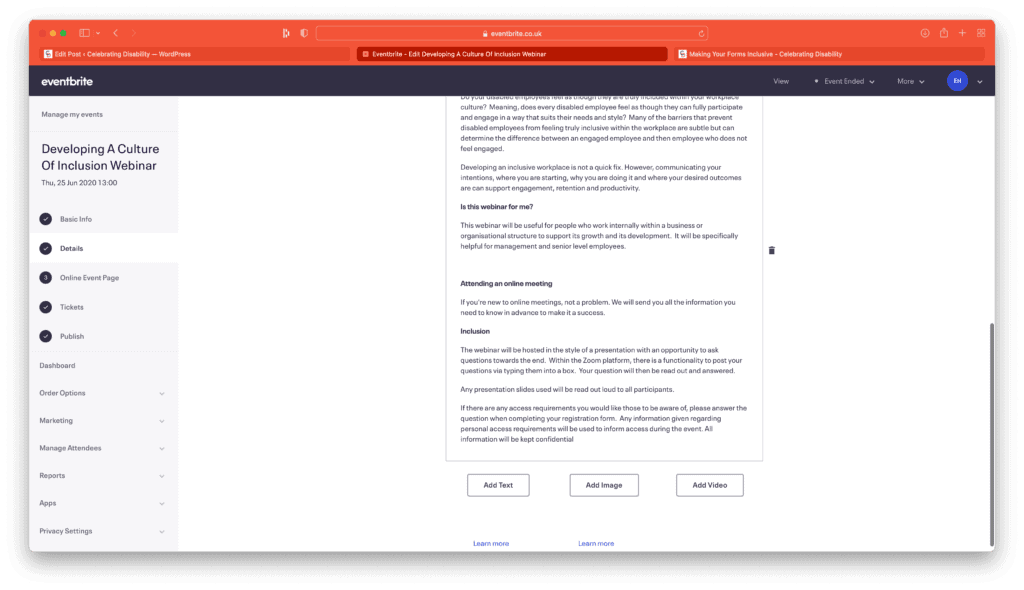
We provided the following information: We provided the following information:
Inclusion
The webinar will be hosted as a presentation, allowing time for questions at the end. Within the Zoom platform, participants can submit questions by typing them into a designated box. These questions will be read aloud and answered during the session. Any presentation slides used will be read out loud to all participants. If there are any access requirements you would like us to be aware of, please let us know.
Asking the question
So many people are nervous about asking the question. It may come from a fear of the answer. But really, what is the worst that can happen? As a disabled person, I do not sit at home thinking, “How can I make this business’s life more difficult?” Many disabled people have already found ways to manage their disability. The access requirements we have are often free to put in place, or something that should already exist, such as an accessible toilet.
Others don’t ask because nobody has complained in the past, so they conclude there is no need. The reason nobody has complained is that people did not know support was available. They may simply have gone somewhere else.
Make suggestions
Not every disabled person knows exactly what they will need to feel truly included. They may not know what will happen when they arrive, or what support is available. This is where you can fill in the gaps.
Start by explaining what is going to happen and what they will need to do. This might be the process of an interview, or an event they are attending. The more information you offer, the better informed the person can be about the support they may need.
Offer a list of suggested support. This helps disabled people who need more encouragement to ask, and reinforces the message that you are inclusive and want to welcome disabled people into your business.
Offer alternatives
Offering alternatives to an online form makes sure you are not excluding anyone. You might offer a downloadable Word document or a contact number. That number should connect the person with an employee who can help them complete the form, and who has the information they will need.
Engage with the response
When you ask any question, you should have a plan for dealing with the response. What is your process for putting in place the reasonable adjustment an attendee has requested? At the very least, contact the person to thank them for getting in touch, and explain the next steps, if there are any.
If you do not know how to put the requested support in place, be honest and say so. You can work with the person to find a solution that suits them within your budget or limitations. If, after discussion, it is something you cannot provide, talk it through with them. Explain why it is not possible and what alternative you have in mind.
Follow up
After your event, follow up with all your guests and ask how they found it in terms of inclusion and accessibility. Ask whether anyone had access requirements when attending, and ask those who did how they found the experience. Use this knowledge to improve your service in future.
If you take only one thing from this blog, let it be confidence. Too many people avoid the conversation for fear of getting it wrong. It is better to get it wrong and ask how to correct it than not to ask at all.
Ensure staff confidence
Whether you are preparing for inclusive recruitment of disabled candidates or want disabled guests and visitors to have an inclusive experience, your staff need to be confident. Provide resources, training and support so they feel comfortable discussing disability and support needs. Your staff are the gateway to building confidence among your disabled contacts, so it’s important to get it right.
After the Form: Supporting Managers to Have Confident Conversations
Asking about access needs is only the first step. The real work starts once someone answers. Presumably, that person will be joining your workplace. Are your line managers confident about starting regular conversations about support needs? How will access needs become part of the team’s day-to-day work?
This is exactly where many organisations get stuck. The form is right, but managers don’t know what to do next.
Reasonable Adjustments in Practice is a 3 hour online workshop designed for exactly this moment. It gives managers the confidence and practical tools to talk about adjustments, agree what works and keep the conversation going.
Wednesday 14 October 2026, 10am to 1pm, online.
Book a Spot.
Is Your Form Actually Doing Its Job?
Disabled people are unlikely to share their access requirements unless they can see how it will benefit them and feel confident to do so. Compare your forms against the questions below:
- Have you explained why you are asking the question?
- Does your form say what you will do with the information and how you will store it?
- Is there a clear way for people to get in touch to talk further about access needs?
- Does your form force the reader to identify as disabled in order to ask for support?
- Do the people writing your forms feel confident asking about access needs?
If any of these answers give you pause, Celebrating Disability can help your managers and hiring teams build the confidence and skills to get it right. Book a call about manager training.
Do the people writing your forms feel confident to ask about access needs? If not, let us help you develop their confidence and skills. Click here to get in touch.