Celebrating Disability Blog

Asking About Access Needs on a Form

  • Explain why you are asking the question and how the information will be used to improve accessibility and inclusion.
  • Avoid forcing people to identify as disabled in order to ask for support. Instead, ask about “access requirements” or “access needs”.
  • Describe what the process, event, or interview will involve so people can better understand what support they may need.
  • Offer examples of possible support or adjustments to encourage people who may not know what to ask for.
  • Ensure staff are confident responding to access requests and have a clear process for following up and discussing support needs.

It can’t be emphasised enough, the importance of providing services that are inclusive of both disabled customers and employees. One way to ensure access and inclusion is by asking about access needs on a form. The way you phrase your questions can significantly impact your ability to adapt and make a disabled person feel included and engaged. However, if these questions are not well-crafted, they could lead to negative consequences for your business. 

According to a report produced by EvenBreak, a disability job board, 12% of disabled applicants reported disclosing a disability at the application stage, and 23% reported disclosing a disability for the interview.

Before strategizing how to ask the question, it’s important to understand the consequences of not having an inclusive service.

Bias can manifest in the engagement process, whether for recruitment or for feedback on a product or service. Unconscious bias from hiring panels and decision-makers can be influenced if disability is disclosed on a form. 

Asking about a disability on a form may be interpreted as a means to discriminate. If a disabled person is not successful in their application after disclosing their disability, both the candidate and the business might perceive this as a discriminatory act based on disability.

Additionally,

Not every person who requires support identifies as having a disability. Some individuals may simply select the “no” box if they do not view themselves as disabled. Therefore, asking someone about their disability and receiving a “no” response may ultimately render the question irrelevant.

Phrasing the question incorrectly may not yield the answers you need. For instance, if you ask a disabled person what their disability is, their response may not inform you about the specific support they require. For example, if I tell you I have cerebral palsy, do you automatically know what support I need?

Building a Truly Inclusive Service

At the form-filling stage, it’s not essential to know if a person is disabled. We should focus on evaluating candidates based on their qualifications and merits rather than personal characteristics. However, it is crucial to understand individuals’ access requirements to ensure accessibility and inclusion.

How to Ask About Access Needs and Disability on a Form

You can ask:  

“Do you have any access requirements you would like us to be aware of?”  

The term “access requirements” is my preferred term. However, access needs is becoming a popular and prevalent term. I think the reason for this is that when using the term “requirement”, it could be framed as optional. Whereas the term need reinforces that this is not an option.

This question can encompass a wide range of needs for those filling out your form. For example, access requirements are not limited to disabilities; a parent may need to leave at a specific time to pick up their child from nursery school, which could mean they cannot attend interviews between 11 AM and 1 PM.

Communicating Your Commitment to Inclusion

Tailoring a service or experience to be inclusive and accessible can significantly enhance it for disabled individuals. It helps them feel valued and welcomed and encourages confidence in asking for specific support needs.

Here are some elements to consider alongside asking about disability on a form:

Creating the Conditions for Genuine Inclusion

Once we have identified an appropriate alternative question to gather the necessary information, we should also focus on how to frame the question to encourage responses. Before asking, “Do you have any access requirements you would like us to be aware of?”, consider how to set the scene.

People, especially disabled individuals, are more likely to engage with your feedback question if they understand why you are asking it. Without this understanding, it’s natural for them to feel suspicious about the use of that information. Take some time to explain why you are asking the question, what measures you currently have in place to ensure accessibility and inclusion, and how you will use the information provided.  We talk about this a lot in our training sessions, especially “accessible and inclusive events”.

When discussing how you will utilise this information, it’s important to go beyond just compliance with GDPR regulations, although that is crucial. You must ensure that the respondents understand how their information will help enhance their experience. People are more likely to respond honestly if they comprehend the rationale behind the question being asked.

 During lockdown, I hosted a series of webinars for the general public. Each session included a paragraph explaining how the webinar was designed to be inclusive, why we were asking about access, and how the gathered information would be used.  The screenshot the followers is a snapshot of the information we provided. Alt Text is provided below.

The image contains a screenshot of an Eventbrite page listed by Celebrating Disability when hosting an online event during lockdown. The text within the image talks about accessibility and inclusion during the event and reads: The webinar will be hosted in the style of a presentation with an opportunity to ask questions towards the end. Within the Zoom platform, there is a functionality to post your questions via typing them into a box. Your question will then be read out and answered. Any presentation slides used will be read out loud to all participants. If there are any access requirements you would like those to be aware of, please answer the question when completing your registration form. Any information given regarding personal access requirements will be used to inform access during the event. All information will be kept confidential
Providing information when asking about disability in a form – Celebrating Disability

We provided the following information: 

**Inclusion**  

The webinar will be hosted as a presentation, allowing time for questions at the end. Within the Zoom platform, participants can submit questions by typing them into a designated box. These questions will be read aloud and answered during the session. Any presentation slides used will be read out loud to all participants. If there are any access requirements you would like us to be aware of, please let us know.

Asking the question 

So many people are nervous about asking the question. It may have to do with a fear of the answer – but really, what can the worst scenario be? As a disabled person, I do not sit around at home thinking, “How can I make this business life more difficult?”  Many disabled people have already found ways to manage a disability. Therefore, the access requirements that we require are either free to implement or something that should be pre-existing in the first place (for example, an accessible toilet

Others don’t ask the question as they conclude if nobody has complained in the past, there is no need to ask now.  The reason why nobody has complained in the past is that they do not know that there is support available. They may have simply gone somewhere else.  

Make suggestions 

Not every disabled person knows exactly what they will need to feel truly included in the process.  This may be because they don’t know what is going to happen when they get there or it may be because they don’t know what support may be available to them.  This is where you can fill in the gaps. 

Start by explaining what is going to happen and what they will need to do.  This might be the process of an interview they will be attending, or an event they are coming to.  The more information you can offer, the more informed the person can be about the possible support they may need.

Offer a list of suggested support.  This helps disabled people who need more support and encouragement to ask.  This will also reinforce the message that you are inclusive and want to value and welcome disabled people into your business. 

Offer alternatives 

By offering alternative solutions to completing an online form, you can ensure that you are not excluding anyone. You may consider offering a downloadable Word document or a contact number. This contact number should connect the person with an employee who can help them complete the form. Ensure the person is equipped with the information they will need. 

Engage with the response 

When you ask a question (any question) you should have a strategy for dealing with a response.  What is your process for implementing that reasonable adjustment your audience attendee has requested?  At the very least, you should be reaching out to that individual to thank them for getting in touch.  Explain what the next steps in the process are – if there are any. 

If you do not know how to implement the support the individual has asked for, be honest, say that!  You can collaborate with that individual to find a solution that works for them within your budget and/or limitations.  If after discussion, you find it is something you cannot implement, have that discussion with the disabled person.  Explain why it is not possible and what alternative you have in mind.  

Follow up 

After your event, follow up with all your guests by asking them about how they found your event in terms of inclusion and accessibility.  As before, ask if anyone had any access requirements when attending.  All the people who answer yes, you can ask follow-up questions about how they found the experience.  Use this knowledge to improve and develop your service for the future.

If nothing else, the most important thing to take from this blog is confidence.  Too many people don’t engage in the conversation for fear of getting it wrong. It is better to get it wrong and to ask how to correct it than to not ask in the first place.  

Ensure staff confidence

Whether you are preparing for inclusive recruitment of disabled candidates or want to ensure that disabled guests and visitors receive an inclusive experience, it is important to ensure that your staff are confident. Provide resources, training, and support to enable them to feel confident discussing disability and support needs. Your staff are the gateway to encouraging confidence amongst your disabled contacts. Ensure you get it right!

After the Form: Supporting Managers to Have Confident Conversations

Asking about access needs is only the first step. The work starts after somebody answers. Supposedly, that person will be joining your workplace. Are your line managers confident about starting daily discussions about support needs? How will access needs be woven into the team’s daily work? Conversations about Support training sessions can help your line managers and hiring teams understand how to embed these access needs into your workplace’s day-to-day operations.

Is Your Form Actually Doing Its Job?

Disabled people are not going to share the access requirements unless they see how it may benefit them and that they feel confident to do so. Compare your forms to the questions below to see how they match up.

  • Have you articulated why you were asking the question?
  • Does your form specify what you will do with the information and how you will store it?
  • Do you have a clear process to enable people to get in touch to talk further about access needs?
  • Does your form force the reader to self-identify as a disabled person in order to ask for support?

Do the people writing your forms feel confident to ask about access needs? If not, let us help you develop their confidence and skills. Click here to get in touch.

Setting Goals for Disability Inclusion

Generally, we will remember one or two items, forget a lot more and pick up many items that we would not have otherwise. 

Whereas, when we write a shopping list, we are more likely to stick to it. We have already spent time thinking about the items that we need to make the meals we want to cook. Many of us will have a budget in mind and this budget provides a guide. We may pick up one or two items along the way that are not on the list. However, these items generally complement the overall shopping list. We can walk away from the supermarket feeling positive and confident that we have what we need to do what we want.

This analogy can be attached to goal setting for disability inclusion: when we understand what we want to achieve, it is easier to achieve it. And, is easier to identify when it has been achieved. As a result, we can then understand where the gaps are and what still needs to be done. 

Establishing goals for disability inclusion

The first thing to consider is what you want to achieve. Start by asking what the barriers to disability inclusion are in your workplace. In the past, clients have identified a lack of information and awareness about what the barriers are. Other clients identify a lack of resources to implement.  There are many inequities facing disabled employees in the workplace. Understanding some of these may help you know where to start.

Consider what people will go away thinking, feeling and doing as a result of the service. This creates a visual image of what the workplace looks like as a result. You can then work backwards to consider how to get there. 

How to set your goals

Goals setting can be a daunting task if you think you have to do it alone. The great thing is, you don’t! The most effective goals are set in collaboration with other stakeholders: colleagues, co-workers, disability networks, or ERGs. You can also engage Celebrating Disability to help you set your goals! When we talk to you about delivering a service, we don’t just leave you to it. We help you through the process. That includes helping you think about what you want to achieve and setting those all-important goals. 

Aligning KPIs to help prioritise goals

Measuring the impact of your workplace on disability inclusion is an important step that helps you understand where you’ve come from, where you’re going, and why it’s important. The right KPI can help you determine which steps to take and where to focus your efforts. This document can help you consider your KPIs and where to focus your data analysis.

How Celebrating Disability Help

There are many stages where we support you to determine your goals and next steps for disability inclusion:

1. When we have an initial conversation with you, we will ask you some of the questions that are listed above. As a result of the answers you provide, we will tailor content for the service we are delivering to reach that outcome

2. Often, when delivering a talk, we find that many organisations can define their next steps through the content that we are delivering. This is because we provide information about barriers faced by disabled people in the workplace that enable people to think about what the problem is and therefore what they want to achieve.

During sessions, we use a tool called Slido. This provides participants with opportunities to interact anonymously. The data gathered from this interaction will enable us to identify what needs to be done

3. When delivering a talk or a training session, we provide opportunities for participants and delegates to set pledges. We follow up on these pledges a few weeks later to provide you with information on how achievable they have been for participants.

4. Pre and post-session benchmark surveys can support you to understand where knowledge, confidence levels and abilities have developed as a result of disability inclusion training.

5. We can carry out a gap analysis or audit of specific areas within your workplace to understand what needs to happen. We will then provide recommendations alongside quick wins

This sounds a lot, where do I start?

It may sound a lot and it may even sound daunting but it’s very exciting. You’ve made the first step already by deciding that disability inclusion is a priority. You should congratulate yourself on that.

The first thing that I suggest for you to do is to get in touch with us. We can arrange a time and date for us to talk together about your goals for disability inclusion. We’ll talk about your workplace, what (if any) barriers you have identified that exist and then we can suggest to you ideas of where to get started. Ready to do that straight away? Click this link to book a date and time to talk to Esi.  

Here are a few other ideas that can get you started when thinking about your goals for disability inclusion:

• Find an opportunity to free-flow your ideas. This could be as a mind map, a bullet list, or anything else that works for you. I find when I talk out loud, my ideas flow more freely than when I purely think about it

• After you have free-flowed your ideas, challenge yourself to think about what else. Repeat that sequence. Keep going like that until you have run out of ideas 

• Consult others, this could be inside the workplace but could also be external. If you need to keep specific ideas confidential, talk about them in general rather than the specific 

How we’ve helped others

If you’re interested to see how we have supported other organisations to achieve their disability inclusion goals, click here to read some case studies.

Spoon Theory: Disabled People’s Energy Levels

When I started delivering training, people would say to me all the time:

I asked if a disabled person needed help and they were rude to me so I don’t want to ask again 

And my response was often: 

I think, as disabled people it is our responsibility to be polite because, if we are rude, next time people may not ask again 

I don’t say that anymore. For many reasons, I don’t think it is our responsibility as disabled people to educate society. Personally I choose to take it as my responsibility. However, I don’t believe that just because a person is disabled, they must take responsibility for everybody else’s learning. 

Unnecessary use of a disabled person’s energy levels

Thinking back to where we started in this blog article, often when a disabled person snaps, it is not because they are meaning to be rude, it can be because a person has come to the end of their tether. Considering all of the other barriers that person may have faced in the day, one more barrier may break the camels back as it were.

This is a nomad way suggesting that it’s okay for people to be rude. I am simply trying to offer another side of the coin to consider.

It is also not a suggestion that nobody should ever ask a disabled person a question. However there are appropriate times to ask questions and there are times when it is not appropriate:

An appropriate time may be when a person has built a rapport with the other person. Due to their relationship, they understand that this is something that is welcomed.

An inappropriate time maybe on the street because the person doesn’t know what else to say. I have experienced this from time to time. It may be when I’m ordering a drink, it may be waiting for a bus.

Spoon Theory

I came across this theory originally hypothesised by Christine Miserandino. She utilised this as a way of describing disabled people’s energy levels; that everyone has a finite amount of spoons per day. Spoons translate to the levels of energy we have. Each spoon represents one strand of energy. Depending on the circumstances, our experiences, our encounters that day, our backgrounds, our exposures to oppression, how we identify – we may exert more or less effort and therefore energy over certain tasks. Everyone has 10 spoons per day and when those spoons are gone, they are gone.

A disabled person, exposed to ablism may at times, may use several spoons on one activity. To another person, this activity may seem relatively simple and straightforward and it’s hard to understand why it would take so much effort to achieve. However, to that disabled person, attempting to achieve a task in an environment not designed to support them, this can be quite difficult. We talk about ways in which the workplace can be made more accessible for disabled people in many other blogs. Including this one.

People with invisible disabilities sacrifice their spoons because as well as managing their impairment on a daily basis, their energy levels are used up when forced to justify their impairment time and time again.

For disabled people, it’s often hard for us to articulate how the spoons are being utilised. Especially when much of what is happening is going on behind-the-scenes. But many of us have an invisible backpack that we carry around every day. Depending on the day, we may manage fine, another day, everything may be too much. The example below is taken from the perspective of somebody with anxiety and depression. 


You wake up with your alarm at 7:30. You were anxious during the night and therefore could not turn off and did not sleep very well.

You look out the window and realise it’s quite cloudy outside. You were hoping for better weather as you thought this might improve how you’re feeling. You’re just gonna have to manage. All you want to do is crawl back under the covers

Your daughter comes running in with marmite all over her hands telling you that she’s made her own breakfast! She comes to give you a hug, misses and get marmite all over your bedsheets

You pull yourself out of bed and go into the bathroom. You realise that the toothpaste is empty and has been put back in the toothbrush holder. You feel exhausted

After rummaging around for another tube of toothpaste, your anxiety is building as you realise that it is now 8:15 and your daughter is still not ready for school

It’s so hard to find the energy to get dressed. However, somehow you manage

Your partner calls upstairs to say that they are take your daughter to school. Although this relieves some of your anxiety, it is swiftly replaced with guilt for not doing yourself

Somehow it’s 9 o’clock. How did that happen? You go into your home office and turn on your computer but it has decided to do an upload. You are going to be late for your 9:15 am meeting

You are revelling in the peace and quiet you have for 5 minutes. Just as you are beginning to relax, your partner comes in and offers you a cup of coffee. Your moment of peace is lost

The zoom meeting loads up, your manager sees you have entered the room and says: “nice that you could join us”. You burst into tears


A lot of the time, many of the tasks that we face as disabled people go on behind the scenes. They can be, as the example above suggests be internalised. However, they can also be physical barriers that happen without anybody seeing. For example, a physically disabled person in accessible loo wouldn’t necessarily be showing that they were struggling because they were behind the door before. An individual may think that they are taking a longer amount of time but do not realise what is going on in that room. Meanwhile that disabled person may be using energy on such activities as:

  • Mentally scooping the room to see where the dangers and potential trip hazards are 
  • Manoeuvering a wheelchair to park in a certain place 
  • Shutting and locking the door 
  • Reaching for the toilet roll without falling off the toilet

All of which may be happening whilst they know that their family/ friends/colleague/clients are waiting for them. They may be aware that other disabled people are queueing outside to use the toilet or that whilst they are in the toilet, they are missing the event/gig/talk/meeting that they are meant to be in. 

2 questions to consider: 

How do your spoons get used up? 

How can you articulate to your customers, colleagues and employees that you realise they have spoons of their own?

Our video demonstrating accessibility versus inclusion enables practical applications of how disabled people’s energy levels are used up on daily basis. Click here to watch the video

Including Disabled People

When we consider including disabled people, there are many terms that bounce around the disability inclusion and diversity inclusion space:

  • Equity and equality
  • Impairment and disability
  • Accessibility and inclusion

Including Disabled People: Accessibility vs Inclusion

We will focus on the former at a later point but today, I would like to focus on accessibility and inclusion. I believe this is an example where there is a lot of speculation about the meanings of the two. I’ve seen them used interchangeably; suggesting that they mean the same thing. But they don’t:

Accessibility means a person can access something. This relates to the tools, resources and structures available. They may be tangible. For example a ramp into a building or an automatic door.

They can also be intangible. For example a hearing loop installed in a building or closed captions available on a digital meeting.

Inclusion means that the attitudes and behaviours of the people surrounding the person that needs access are such that the person actually wants to be there. For example, for a person to feel included and valued as a customer, the business will have considered the customer’s experience:

For example a restaurant may have an accessible toilet installed. However, if a disabled person has to manoeuvre through tables of patrons and ask every single one of them to move out of the way, then that person may not feel welcomed, included or valued.

Beyond the Physical

The feelings evoked by disability exclusion are not just exclusive to people with physical disabilities: people with invisible disabilities also have similar experiences. In a workplace meeting. It may be expressed that anyone can move around during the meeting if they need to. However, the meeting will not stop for anyone. As a result, somebody with ADHD who is unable to stay still for long periods of time feels isolated and is prevented from taking part in discussions.

Lived Experiences

Over the last few years, I’ve asked around for people’s experiences of what inclusion means to them. Overwhelmingly, people have commented that including disabled people happens when a person feels relaxed: as disabled people, often we have to think five steps ahead of what is coming before anything happens. This is so that we can plan for the worst but hope for a good experience. This happens as a result of knowing that society has not fully thought about our barriers. Society has also not fully thought about how we would like to share in an experience.

A disabled person may be able to access the bar. However if the bartender does not take the time to communicate with us in the way that we need them to, then our experience is diminished. It’s very hard to only remember the good experiences of the night out when half the night has been taken up by battling to get a drink, get on the dance floor, have a conversation, etc.

Iterations

We can see iterations of this same thing repeated everywhere we look:

  • On an online booking page. When a disabled guest has to call to check accessibility rather than the website providing clarity that this will be provided
  • An accessible toilet that is always locked. Requiring a specific key (radar key) to unlock the toilet. Although not all, many disabled people need support to open and accessible toilet as radar keys are not accessible for those with limited dexterity. Meaning that we cannot go to the loo without asking for support from the public. An inclusive alternative would be to leave all accessible toilets open for everyone
  • A workplace reasonable adjustment policy that requires a disabled person or their line manager to take several steps before something can be implemented. An inclusive alternative could enable a one step, simple process for implementing a reasonable adjustment

An Animation to Demonstrate Including Disabled People

With all this in mind, we have created an animation video to demonstrate the valuable difference between accessibility and inclusion. We were lucky enough to work with video production and animation agency Cass Productions to create this video. Please take a look and if you have any questions, please do reach out and speak to us.

Remember Accessibility

Throughout all of this, please remember to prioritise accessibility at the same time. After all, there can be no inclusion if there is no accessibility. If a disabled person cannot access the venue or the meeting, there is no point in making it inclusive. In order to work together, consider accessibility and inclusion on their own merits.

It’s not imperative to get it right first time. There is no such thing as fully inclusive or fully accessible. “Fully” accessible or inclusive cannot possibly exist because every disabled person is unique and has unique requirements.

Many disabled people (including myself) believe that as long as we can see the intention, it doesn’t matter if the access is not perfect. This is because the intention and behaviours of people supporting us make the experience inclusive.

How Do I Make My Business Inclusive For Disabled Customers?

Why Asking About Access Needs Matters for Disabled Customers

Many organisations worry about asking the question incorrectly. Others avoid asking altogether because nobody has complained in the past. In reality, disabled customers may simply choose not to engage with a service if they cannot see evidence that support is available.

Creating inclusive forms is not only about collecting information. It is about creating confidence, trust, and a sense of welcome from the very first interaction.

In an episode of The Equality Edit, Joe Colett from Squee discusses the prevalence of disabled customers leaving websites when they find them inaccessible to their needs.

Why Some Disabled Customers May Not Answer the Question

Disabled customers are more likely to engage with your form if they understand why the information is being collected and how it will improve their experience.

Without this context, questions about disability can feel intrusive or even discriminatory. If somebody discloses a disability and then has a negative experience afterwards, they may question whether that information influenced the outcome.

Not everybody who requires support identifies as disabled. Some people may select “no” when asked if they are disabled, even though they still require adjustments or support.

This is why asking directly about disability often does not provide the information businesses actually need.

How to Ask Disabled Customers About Access Needs

Instead of asking somebody to identify themselves as disabled, a more inclusive approach is to ask:

Suggested Question

“Do you have any access requirements you would like us to be aware of?”

This wording focuses on the support required rather than a label or diagnosis.

The phrase “access requirements” can apply to a wide range of situations, not only disability. For example, somebody may need flexibility around timings, communication preferences, or physical access arrangements.

Importantly, asking about access requirements also avoids assumptions. If somebody states they have cerebral palsy, autism, or another impairment, this does not automatically explain what support they need.

Explain Why You Are Asking the Question

Before asking disabled customers about access needs, explain:

  • Why the question is being asked.
  • How the information will be used.
  • What accessibility measures are already in place.
  • Who will have access to the information.
  • How the information will improve their experience.

People are more likely to answer honestly when they understand the purpose behind the question.

For example, during a series of public webinars, we included a paragraph explaining exactly how the sessions were designed to be inclusive, how access information would be used, and what support was already available.

This encouraged disabled customers and attendees to feel more confident engaging with the process.

Help Disabled Customers Understand What Support Is Available

Not every disabled customer knows exactly what support they may need until they understand the process involved.

Explain the Process Clearly

Start by explaining:

  • What will happen.
  • What the person will need to do.
  • What the environment or experience will involve.

This could relate to:

  • An interview.
  • An event.
  • A booking process.
  • A customer appointment.
  • A consultation or meeting.

The more information people have, the easier it becomes for them to identify barriers and request support.

Offer Examples of Support

Offering examples can encourage disabled customers to ask for support they may not otherwise realise is available.

For example:

  • Quiet spaces.
  • Flexible timings.
  • Accessible seating.
  • Step free access.
  • Alternative formats.
  • Additional breaks.
  • Communication support.

Providing examples also reinforces the message that your business genuinely wants disabled customers to feel welcome and included.

Offer Alternatives to Online Forms

Inclusive businesses recognise that online forms may not work for everybody.

Consider offering:

  • A downloadable Word document.
  • An email option.
  • A telephone number.
  • Support completing the form with a member of staff.

Providing alternatives can prevent disabled customers from being excluded before they even engage with your service.

Respond Properly When Disabled Customers Share Access Needs

Asking the question is only useful if there is a clear process for responding to the answer.

Acknowledge the Request

At a minimum:

  • Thank the individual for sharing the information.
  • Explain what will happen next.
  • Confirm any agreed adjustments or support.

Be Honest If You Are Unsure

If your organisation does not know how to implement a requested adjustment, be honest about it.

Disabled customers often appreciate openness and collaboration more than silence or avoidance. Work together to explore realistic solutions and alternative options where possible.

Follow Up After the Experience

After an event, appointment, or interaction, ask disabled customers about their experience of accessibility and inclusion.

This helps organisations:

  • Identify barriers.
  • Improve future experiences.
  • Build confidence with disabled customers.
  • Demonstrate that feedback is valued.
  • Measure growth over time.

Continuous improvement is an important part of creating genuinely inclusive services.

Ensure Staff Feel Confident Supporting Disabled Customers

Many organisations avoid conversations about disability because staff are worried about saying the wrong thing.

Confidence is essential.

Provide staff with:

  • Disability inclusion training.
  • Guidance on discussing support needs.
  • Clear processes for implementing adjustments.
  • Opportunities to ask questions and practise conversations.

Your employees are often the gateway to whether disabled customers feel welcomed, respected, and included.

Supporting Disabled Customers Beyond the Form

Asking about access needs is only the first step. Inclusion must continue throughout the entire customer experience.

Businesses should consider:

  • How support needs will be communicated internally.
  • Whether frontline staff understand agreed adjustments.
  • How accessibility will be maintained day to day.
  • Whether disabled customers feel confident raising concerns.

Creating inclusive experiences for disabled customers requires more than a single question on a form. It requires confidence, communication, and a commitment to turning accessibility into everyday practice.

Disability Awareness Session – What’s Your Goal?

What are you doing before and after your disability awareness training session or talk? How are you measuring the impact of the session? How are you ensuring you meet the needs of the audience?

Now, when I say meeting the needs of the audience, in this context I am talking about making sure the content matches the information needed. Meeting the needs of the audience can also mean making sure it is accessible and inclusive for engagement purposes. I have written articles about this as well. To find out more about this topic, you can read this article here.

It’s all about return on investment

That may sound cold, but it’s not. You have not only invested in me or your trainer of choice to deliver your session. You have also invested in the employees to deliver the service/product that you hired them to deliver. We may know of the business case for diversity and inclusion. Caroline Casey, Founder of The Valuable 500 talks about the business case for disability inclusion here. Therefore, when we create cultures that are inclusive, welcoming and safe for disabled employees, the outcomes, innovation, psychological safety, happiness and productivity of the whole workforce is improved.

Much of the reservation around disability inclusion is not knowing what, why and how. By providing training and consultancy support in the right way, you can work with your employees stamp out and eradicate the elements that stop people from purely opening up, communicating and learning from each other. With that in mind, try to ensure that your disability awareness session meets the needs of the people that are not only going to be in the room but are indirectly going to be benefiting from the session in the long run. These may be: colleagues in the office, direct reports of line managers, disabled employees and candidates across the organisation and disabled customers using your service or product. To name just a few!

Why do you always say disability awareness and not disability inclusion?

If the disability inclusion expert used language in her blogs that nobody ever searched for and therefore never read, do those blogs exist?

Where I write on my website and on my blogs, I deliberately use language that people are going to search for when they’re looking for answers. Otherwise, nobody would ever find anything! It is not common language to use terms like “disability inclusion”. Therefore, to engage you in the first place, I will use the language that you will be typing. However, as you will know from content written, awareness is just the start; inclusion is what we will do together.

Why are you focusing on disability?

This is not a trick question. For many organisations, disability is not an obvious priority. For many organisations it is a far 3rd after persons of colour (POC) and women. Although there are many reasons that this may be the case, we will not go into that in this article.

As a disability inclusion expert, I of course am going to champion disability for being a top priority as it should for many reasons including the fact that the prevalence of disability is growing and disability is diverse and intersectional. By this, I mean that as a disabled person, within the realms of disability alone, I identify as a physically disabled wheelchair user with limited mobility and extra care support needs. That is not even getting into all the ways I identify beyond my disability.

You might be looking to create a more inclusive recruitment process that extends the talent pool pipeline of potential candidates. Or understand more about what the physical barriers to the built environment are that stop disabled people physically accessing and therefore feeling included in the workplace. It may be developing the routes to engagement on your website.

Finding your reasons

This isn’t something that you should feel you have to do alone. After all, this is part of what your trainer is for! As well as your trainer, you can utilise your assets. By this, I’m talking about your employees. They will definitely have an opinion. As we discussed above, disability is intersectional. Therefore, just because you can’t see it, doesn’t mean it’s not there. This also means that you will need more than one experience to help you find your reasons.

So… Here are some of the ways you may want to get started:

Co-creating and co-designing

Co-creating and co-designing is where every user group comes together to design the outcome. Everyone in the room has the same level of agency, access to the same tangible and intangible resources and information. Co-creating a service or training session with your disabled and non-disabled employees ensures everyone’s experiences are heard and implemented into the structure and outcomes for the session.

Equality impact assessments

Equality (or equity) impact assessments are used to audit policies, documents and any process within the organisation from strategy to operational. They are designed to assess the impact on the workforce and/or customer base in terms of equality, fairness, diversity and inclusion. After completing an equality impact assessment, you will have a better idea on what needs to be improved and where to start.

Your delegates

Don’t forget to ask your intended delegates what they would like to receive from their disability awareness session. Many of the time, the delegates attending and participating in the session are operational and strategic staff. Having insight into what it is like working within the organisation on a daily basis and/or working with disabled customers will really help to shape the delivery of the training.

Ask the audience

There are many ways that you can instantly ask your audience for feedback. Understand how they are getting on, whether they feel included and what they feel needs to be improved. This will be a really easy and simple step to help you create your goals for your disability awareness training.

If you would like to talk informally about how we can support you to implement some of the suggestions above and to deliver disability awareness sessions within your organisation, speak to Esi. You can do this easily by clicking here.

Choose to Challenge Positively

Choosing to Challenge is not always that easy

Yesterday was International Women’s Day and the theme is “Choose to Challenge”. Now, don’t get me wrong. I think this is a really good theme for a day that is all about empowering others. However, I think that the statement “Choose to Challenge” leaves room for interpretation. Not least of all, it assumes that the individual that is choosing to challenge has the confidence and the psychological safety to do so.

It assumes that the person doing the challenging, has the capacity to articulate in a way that is going to be understood by the receiver.

The other thing about Choosing to Challenge when you are not confident to is that all of your energy is taken up on speaking and saying the words. A big part of positively challenging somebody’s perceptions is how we come across. How we hold ourselves – our body language, the terms and vocabulary we use and our literal tone the voice. Without confidence, this all goes out the window. If you are not a speaker, imagine the feeling of having to get up in front of a room of people and present an idea. How do you think it will come across? Perhaps you will stutter your words. Perhaps you will look uncomfortable, perhaps you won’t look at the audience and you will rush through your slides. This is what will happen to an individual who is not confident but feels as though they have to challenge.

I don’t doubt the people behind the campaign slogan had all the intentions of the campaign message receiver to do this at their own safety and with their own autonomy. But reading the campaign slogan alone does not suggest this.

I wish I was more like others – others are very good at taking pictures when hosting an event. This shows everybody what they’re doing and it is not harmful from a marketing perspective either! I am rubbish at selfies. I think about them far too late in the day when everybody has left the event.

Being a good ally

However, a couple of weeks ago I ran a talk for LiveWesthere is what they said about the event. The talk was on being a good disability ally. During that talk, I spoke about the importance and the ways to go about being an ally for disabled people. The message was that you don’t have to have experienced something to be a good ally, you must be willing to listen and learn from the individual to understand what support they need from you. Sometimes that support can be challenging a bias. Sometimes it can just be listening and being somebody that someone else can bounce an idea off. This is definitely what I found helpful from allies in the past.

A good ally can support an individual to develop the confidence to challenge in a positive, successful way. This brings both parties along the journey to learn something for and about themselves. So let’s explore the notion of supporting another person to develop confidence and to articulate feelings.

Understanding and articulating feelings

There is a model of counselling called person centred counselling. Unlike some others such as psychodynamic counselling, it stays in the conscious and does not venture into the unconscious. For example, everything discussed is what the patient already is aware of about themselves. The principle is that the counsellor holds up a mirror to reflect back to the patient what they cannot see for themselves. In person centred counselling, active listening is utilised. The main principles of active listening are reflecting, summarising and paraphrasing. Using these skills, an ally can support an individual to understand the situation and to articulate the feelings that are revoked.

Supporting development of confidence

It’s not always easy to have confidence. For people that are confident, it is sometimes tempting to say “just have the confidence”. However, this is because it is not an issue for us. Or even if it is, we are very good at covering it. My motto in life has always been “fake it until you make it” and I am very good at compartmentalising. I’m very good at leaving things at the door and returning to them later. This may have been a result of studying as a psychodynamic counsellor where I was taught to leave things at the door. My mantra is quite often “what’s the worst that can happen?” Most of the time I am right. The worst thing that can happen is that somebody says no.

However, for many people this is so much more easily said than done. Experience might tell people that it never works out the way they want it to. It may actually end up 10 times worse. Mental health impairments might be a huge factor in a persons ability to feel confident. Personal backgrounds, family experiences for example, might be ones where people have said that it is not worth trying. These examples and many more are why people do not have the confidence to speak up for themselves when otherwise they might.

We, as allies, can support this by understanding and empathising with the person’s situation. We can utilise active listening to support us when learning where the other person is coming from.

It doesn’t have to be done by the individual

In social care, often, the term “independence” is twisted to mean something that it doesn’t. It is utilised as an excuse when trying to get out of paying for a disabled person’s support. Time and time again as disabled people we here: you wanted to be independent so I don’t need to help you”. The suggestion being that if you’re independent, you can do it yourself. However, this is not what independence is. Part of being independent is having the autonomy and personal authority to be able to ask for support when you need it, the way you need it. And this is sometimes the role of the ally.

It may be to support your colleague/friend/coworker to understand we don’t have to do it alone. They might want you to attend a meeting with them or even to have the meeting or the conversation on their behalf.

So, perhaps instead of internalising the idea of Choosing to Challenge alone, the slogan can evolve to say: supporting each other to feel valued. Not as punchy but perhaps a little more accurate.

Disability Inclusive Cultures – Where To Start

Start your disability inclusive culture as you mean to go on

Many organisations want to build a disability inclusive culture but are unsure where to begin. Some practical starting points include:

• Understanding why disability inclusion matters.
• Engaging disabled people and wider stakeholders.
• Removing systems and behaviours that create exclusion.
• Assessing workplace practices to identify quick wins.

While there are no quick fixes to culture change, these areas can help organisations begin turning disability inclusion into everyday working practice.

Did you know, depending on where you look, it can take between 2 and 7 years to change a culture? Predominantly because when a culture is already embedded, it takes a while for people to change behaviours, thought patterns and processes. Those inbuilt, systemic, learned behaviours can be hard to break. However, whilst there are definitely no “quick fixes”, there are “quick wins” to make the journey a little less arduous.

Many organisations I work with through Celebrating Disability know that they want to be inclusive of disabled people and they want to develop the culture of inclusion for all, they’re just not sure where to start.

Where to start with a disability inclusive culture

Understanding why is the key fundamental to unlocking the how and the what. Because it’s how we drive forward as human beings to achieve anything. I know for a fact that I don’t do anything without a reason. When the reason is meaningful to me, it is sustainable and enjoyable to complete the tasks associated.

I used to run drama workshops for adults with learning disabilities. I really enjoyed the time I spent doing this. Once I understood we are all driven to do anything in life by a reason, I learned to support participants to understand what that reason was for them. For me, a person who is able to holistically think of the situation and the pros and cons of that situation, it was easy for me to think about why I was there and what I was getting out of it. But for the people I was working with, this was not as simple. Through a series of questions and answers and activities, we were able to work it out together. After we did this, everybody enjoyed themselves and participated because they knew why they were there. More importantly, everyone wanted to be there.

For individuals to understand their why is slightly different to organisations understanding their why. The former relies on one person making a decision. The latter relies on a community making a decision. This, understandably, has its own complications. Let’s explore some of the areas to consider.

Getting to grips with the fundamentals of your disability inclusive culture

There’s no point in doing anything unless you know why it needs to be done. As we have just explored. So, here are a few starter questions you may want to consider:

• Why is it important to be inclusive?
• Why do disabled people need to feel included?
• What are the ways that people don’t feel included?
• How are disabled people not included?
• What would need to happen for disabled people to feel included?
• What does this mean when disabled people don’t feel included?

Answering these questions will help you have a starting point.

Ensure everyone can engage

It’s not up to a small group of people to have all the answers. The more people involved in the conversation, the more representative the outcome will be of your community. The more stakeholders who can engage in the process, the more likely you are to find a holistic solution that works for you, your organisation, and others interacting with your organisation, i.e. customers.

Accessibility is a key ingredient to successfully ensuring your disabled employees can access any stakeholder event in an inclusive and independent way.

Remove systems that oppress

A person can only engage if they feel safe and welcomed to do so. For disability, a very simple visual representation of this is the following:

If a building has step free access meaning that a wheelchair user can enter but once inside the building, the staff and the other guests ignore that disabled person, then oppression has not been removed.

It is our responsibility as leaders and colleagues to support a disabled person to feel valued and included. How is your organisation supporting the celebration of difference and opinion?

Conduct an internal self-assessment

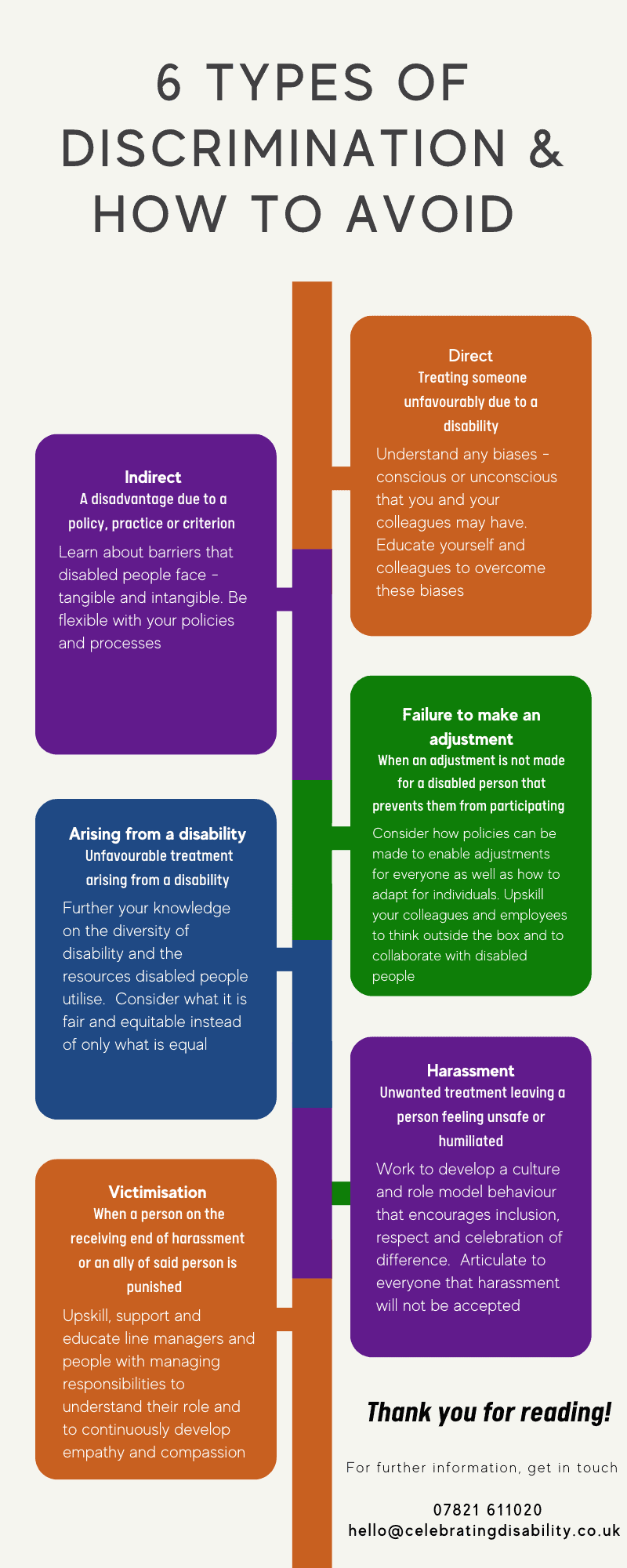
One way to assess your organisation is to compare it with the definitions of discrimination. Disability discrimination often occurs insidiously, in ways we do not recognise until they are pointed out. However, it is there.

The 6 Types of Disability Discrimination outlines the ways in which disabled people can be discriminated against in society. Use this document to identify where your organisation can achieve quick wins.

Accessible Online Events – 6 Quick & Easy Tips

In This Blog: Ensuring you are always hosting accessible online events will support participants to feel engaged, welcome and included regardless of their access requirement.

Quick links

We are all working to keep in contact with our colleagues, employees, friends and family.  Many people are getting to grips with online platforms as a way of ensuring that we can still feel engaged, and part of society. This is working well for many people and in many cases disabled people.  There have been many studies that have shown over the past few months that for many disabled people in the workplace, remote working and online events have been a positive experience:

  • Remote working has helped people to feel less isolated 
  • Disabled people have felt more included and engaged in the workplace culture 
  • Disabled people have felt more productive as they have all their requirements around them 
  • Online events have enabled disabled people to attend and participate. These are often events that people would not have been able to otherwise access 

However, in order to ensure this can remain reality, online events must continue to be inclusive and accessible for disabled people.  I have attended many meetings as a participant and read many articles about how to host a successful online events and meetings. Often these do not consider the needs of disabled people.   The results of these are less engagement of your disabled audience; whether they be customers, employees or potential candidates.  As discussed in an earlier blog, if it is accessible and inclusive of disabled people, it is accessible and inclusive for everyone.  

Engagement during your online event

As hosts of online events and training sessions, we strive to ensure we are engaging as many participants as possible.  We strategise to ensure participation and to make sure that people are alert in order to receive the information we are giving.  We encourage (and sometimes insist) that participants and attendees turn their cameras on. We often don’t consider that accessibility is not just about the physical elements. 

 This is especially true when we are talking about digital platforms.  We must be mindful of those with mental health impairments.  Impairment such as these may not need physical access adaptions.  Instead, an inclusive and mindful approach to how we expect others to interact in our sessions.  This will go a long way to ensuring someone feels safe and confident to engage and interact. 

Quick & easy tips for your accessible online events

Below are 6 quick and easy tips to ensure your online events are accessible and inclusive for disabled people:

Meet access requirements 

This is a relatively obvious one but is often not covered.  The question can be easily inserted and embedded into many of the pre-existing processes.  Perhaps one of the main reasons for this is an assumption that the access requirements people request will not be feasible for the host to deliver.  The reality is, many of the access requirements disabled people request are easy and cheap/free to source.  We will talk about many of these further in this blog. Much of the time, many of the more expensive requirements have already been sourced by the disabled person themselves. 

Ensuring your participants can tell you about any requirements they may need is discussed in another blog.  There are several touch points where you can ask the question. The most important thing is that you are proactive in showing people that you are willing to make your digital event as possible. 

Some key stages to ask the question are: 

  • On the registration page 
  • In the confirmation email and any reminder emails 
  • At the beginning of the session.  This question can be asked as part of general housekeeping

I remind participants that I have my own access requirements that I need them to be mindful of.  I offer them the opportunity to tell me in the chat or in a private message about any requirements they would like me to consider during the session. 

In order for people to tell you about their access requirements, it would help them if you could outline the main elements of the session.  This is not to say you will have to go into content.  However, the more information you can give about what will happen, the more informed participants will be to tell you about anything they require. 

Support participants to engage

I have witnessed many confirmation and reminder emails that have insisted I have my camera on throughout the online event.  For me, this is not an issue.  I feel comfortable and happy to have my camera on and to engage and interact in the discussions.  However, for many, this is not the case.  There are many reasons why this may be an issue for some people. To name a few examples:

  • Unfamiliarity and lack of confidence with digital equipment
  • Unfamiliarity with the other people in the room
  • Anxiety around the subject

Another factor to consider is the subject matter you are discussing.  A colleague Sarah Burrell and I delivered a workshop to Southampton University on disability awareness and mental health.  As our training styles are interactive, we were aware the subjects we were discussing were personal and maybe for some people, difficult subjects to talk about.  Whilst encouraging people to turn their cameras and microphones on, we were aware that people may not want to do that so offered them alternative solutions.  We designed these to enable participants to interact whilst remaining comfortable.  As a result of offering this alternative way, as the session developed, more participants felt able to interact by turning cameras on and speaking through the microphone.    

Insistence from the host to have cameras and microphones on may also create a physical barrier for some.  I know several people with speech impairments who to a differing factor, feel uncomfortable speaking aloud on a digital platform.  This is especially true when nobody on the online meeting platform knows each other. One colleague always prefers to type in the chat box as for him, he’s more confident his message will be delivered clearly and precisely. 

There are many reasons why people may not feel confident to interact via camera and microphone.  The reasons listed above are just examples of a few.  However, what is clear is that there are several preferred methods to engage.  As hosts, it is our responsibility to support our participants to feel confident to participate in whatever way is meaningful for them.  The more you can show your participants you are mindful of alternative methods, the more confident they will feel; encouraging microphones and cameras to be switched on.  

 “Mute yourself when you’re not talking” 

This one seems obvious doesn’t it?  At a time when there are children in the background, washing machines going, people working in other rooms and general background noise, it is sensible to ask participants to mute themselves when they are not talking.  In a room with many participants, you may be tempted to ask people to raise their hands – digitally via the online platform or physically via their hand when they would like to talk. 

This request can inadvertently create an unnecessary barrier for some.  One example of this may be a participant who for whatever reason cannot access the mute button.  I have been to several online events where this request has been made.  However, this is made under the assumption that people can access the buttons on the screen.  If your participants cannot access that button or if they cannot see that button, they cannot mute.

 In other blogs, I have talked about why disabled people may not disclose a disability.  By asking people to mute when not talking, you are inadvertently forcing an individual to disclose a requirement.  For people who are unfamiliar with the platform, asking them to mute themselves may simply be a challenging request as they cannot find the button.  Unnecessary time is then reassigned to supporting people to locate the buttons they need.  This limits the time that you as the host has to spend on your content. It could also create concern or anxiety for the participant who cannot find the button.  A feasible alternative to this is to ask people to mute themselves if they are able to. 

Be mindful that when you muting participants from your end, it may create a barrier for those with access requirements if they would like to speak.  Considering that for many, accessing the buttons can be a challenge, they will not be able to raise their hands, or write in the chat box.  Therefore, they will not be able to actively participate in the session. 

Share screen and slide decks 

As a host, I have taken on best practice within Celebrating Disability to read aloud content on the screen as standard.  In turn, whether in an online meeting or face-to-face, every participant can access and understand the content on the screen.  If I had a participant with dyslexia, or a participant with a sight impairment, they would not have to inform me beforehand.  This also forces me to be selective with the content on each slide; if I write reams and reams of information, I will be reading for ever. Similarly, my participants will be disengaged as the slides will not hold their attention.

I also try to keep images to a minimum; especially images that replace text.  In an online setting, and indeed a face-to-face setting, I would have to describe each image in detail to ensure that every participant can understand what is being portrayed in the image.  

If you are able to invite people to tell you about their access requirements on registration, participants may ask you to send the slide deck ahead of the session.  This is often an access requirement that can help people who have sight impairments.  Screen readers can then be utilised to interpret content and images in the slides or to simply enlarge the text.  Offering this service to participants will help with engagement.

Consider captions 

As a result of a request, I was able to source a service that could offer closed captioning throughout my live events.  This service enabled participants with hearing impairments to participate and engage in the sessions I was delivering.  I have since seen the service pop-up at several points on the Internet over the last few months. 

There are several ways to embed live close captions to your events that do not have to be very expensive. The service that I use is through a company called TakeNote.  There is a close caption feature embedded within PowerPoint.  This How To video on YouTube will show you how to turn live captions on your PowerPoint presentation. 

You don’t need to have all the answers 

It’s not always possible or even necessary to know all the answers straight away. However, what makes a difference is a willingness to be agile and think outside the box to meet individual needs.  Recently, I participated in a training session hosted by The Business Speakeasy.  The online session I attended was designed to support trainees to develop engagement strategies for online training.  The session was brilliant, I would highly recommend it!  

During the session, there were a couple of activities that were inaccessible for me to complete using the method prescribed by the trainers.  Some of these activities were pre-warned and somewhere on the spot.  The trainers created an environment where I as a disabled person felt confident to request an alternative method.  Each time, the trainers very competently found alternative ways for me to participate in a meaningful way.  Sometimes this involved consultation with myself and sometimes they already had an alternative up their sleeve! 

Have you heard about the Disability Inclusion Community? A brand-new online membership community designed specifically for professionals working to develop disability inclusion in their workplace. Join live sessions, engage and interact in the community forum and benefit from a library of resources. Click here to see how your organisation can benefit

Does Disability Inclusion Exclude Others?

In This Blog: disability inclusion is possible for everyone in every business with every level of impairment. Here we will dispel the myth that it is not possible

The Cambridge Dictionary defines inclusion as:

“the idea that everyone should be able to use the same facilities, take part in the same activities, and enjoy the same experiences, including people who have a disability or other disadvantage”

We’ll revisit the idea that disability is a disadvantage in another article.  Although the definition is clear, many people are still pondering how to include everyone in an activity/event.  If you have read this article you may have some ideas. But, is it possible?  What do you think?  How, when disability is so varied and unique to the individual is it possible to be inclusive of everyone? 

I think we need to start with tackling the assumption that we need to do all the work ourselves to ensure disability inclusion.  Yes, as the event host/employer/responsible party, we need to take ownership and initiative over ensuring everyone feels included.  However, this does not necessarily mean that we have to have all the answers.  After all, if everybody is unique, how is that even possible?  Unless you are a mind reader.  

Is disability inclusion another form of exclusion?

I have heard people say to me “well in order to be inclusive we are actually excluding others”.  This is really not the case.  To use a fairly obvious and popular example:  if there was a ramp up to a building instead of a flight of stairs, it does not mean that non-disabled people cannot get to the top.  However, it does mean that a wheelchair user will be able to get to the top.  The same principle applies to what we are talking about here.  If you make it inclusive for the majority, the people who do not need the extra thought will still successfully be able to manage. 

Ensuring disability inclusion takes a little bit of research and preparation.  In the case of an online event, you cannot expect that every single one of your participants attending will not need any extra support or any adjustments made to the style of your presentation. After all, many disabilities are hidden and undisclosed.  It does not necessarily have to be difficult; for example, somebody with ADHD may struggle to concentrate in a webinar lasting longer than one hour.  Therefore, adding in a few extra breaks, a few activities to break up the session would support that specific participant to successfully participate and engage.   

Recently, I discovered on PowerPoint, on the slideshow, you can turn on automatic closed captions.  This means that participants with a hearing impairment will be able to follow along and understand what is being said.  

Those are just a couple of examples of how you can ensure the majority of participants can engage in your event.  However, returning to what I was saying earlier, there are ways to encourage your participants to tell you their access requirements. 

Wait for it:  Ask them!  Yes, it really is that simple.  By asking the question, you are hearing from people themselves about the support they need to engage and participate.  You’ll need to do some groundwork in order to encourage people to feel confident about telling you.  You need to show that you are genuine.  There are many ways to do this and they do not have to be time-consuming or expensive.  A simple statement when asking the question will go a long way to support people to understand why you are doing what you’re doing.  

Oh no wait, it’s that terminology barrier again.  The fear of offending a disabled person by asking the question in the wrong way often prevents people from opening a dialogue.  Don’t worry, you don’t have to ask about somebody’s disability to find out if they have any access requirements.  A simple question is:

“Do you have any access requirements you would like me to be aware of?” 

However, how can the individual answer the question if they don’t know what is going to be happening?  It would be like me saying to you: how should I grow my audience?  You will need some context to answer the question; who I am? What’s my business?  What’s the product/service that I am trying to sell?  Which market am I trying to sell in? What is the target demographic? And so on and so forth.  

Offering context is beneficial

Whilst inclusivity and accessibility are not necessarily the same thing, they are not always exclusive either. As a wheelchair user, if someone asks me about my access requirements, I need to know if the building has step free accessibility before answering the question. If the building does not have step free access, I cannot be 100% included. Offering your potential participants some context will go a long way to helping them answer the question. Explain what you were going to be doing, how long you’re going to be doing it for, if it is a live venue, the venue.  Any breaks, essentially the more information you can offer an individual about what will be happening, the more they will be able to answer your question about any support they may need. 

Where and at what stage are you going to ask the question?  You can ask this question at many stages in the participants journey to your event:  

  • At registration 
  • In follow-up, confirmation emails/conversations 
  • Wherever you are promoting your event – alongside the information of the event, you can have some information about accessibility and inclusion. This could include contact information of the team/person that can be contacted for support or more information 
  • Following the event – many organisations (including my own) ask for feedback.  This is a great opportunity to ask about the inclusiveness of the event.  You could ask as a general question to all your audience members but also you could ask a specific question to people who benefited from your event’s inclusiveness.  Once again, without asking about a person’s disability, you could ask a question similar to the one above.  If the participant answers “yes”, they can be redirected to a couple more questions.  These questions could ask about their experience; how they found the general information, how they found the communication, how they found the event to be inclusive.  

After gathering all of this information, don’t throw it away, return to it and analyse the data.  What could you improve on next time?  What are your learnings?  What went well? 

If you don’t see any results first time, this does not mean that this was not a success or that it was unnecessary.  If customers and employees are not used to seeing these kinds of questions or actions from you, it may take a while for the trust to settle in.  It may also mean that because of the effort you put in at the beginning, there was no need for anyone to come forward.  However, the more you practice the above, the more people will approach you and give you feedback. 

Celebrating Disability Best Practice

Below are the Celebrating Disability best practice guidelines that are utilise when hosting any event to ensure inclusion:

Pre-event

  • Access requirement questions in registration 
  • Proof of genuineness and authenticity (on the Celebrating Disability website) – it’s not always about what you say, it’s what you do 
  • Pre-event questionnaire – an opportunity for participants to tell me anonymously about any access requirements they may have

During event

  • Describing and reading content on all slides and material presented

Post event

  • Inclusion questions in survey 

Is there anything else that I’m missing that you are doing to be inclusive in your events?  Share them in the comments. 

Let’s Talk About Inclusion

We’d love to hear from you.

Explore training and support